




【Graphite Electrodes】Escalation of the Iran Conflict and the "Risks" and "Opportunities"...

【Graphite Electrodes】In-Depth Analysis: Escalation of the Iran Conflict and the "Risks" and "Opportunities" for China's Electrode Industry
I. Overview of the Impact of Escalating Tensions on China's Graphite Electrode Industry
The recent escalation of the Iran conflict has created a significant short-term shock and long-term impact on China's graphite electrode exports.
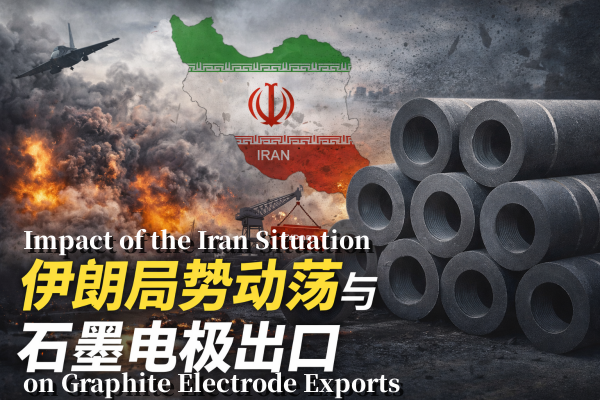
The most immediate effect of the escalation is the disruption of transportation routes. Late on the night of March 2 (local time), Iran declared that the Strait of Hormuz had been closed and warned that it would strike any vessels attempting to pass through, effectively cutting off the primary maritime route for Chinese graphite electrodes to reach the key markets of Iran and the United Arab Emirates.
These two markets are crucial for Chinese exporters. According to China Customs data on graphite electrode export volumes, from 2024 to 2025 the share of exports to Iran and the United Arab Emirates continued to increase. The United Arab Emirates ranked first and Iran third, both showing increases compared with 2024.
Before the conflict escalated, in September 2025 Iran had once become the largest export destination for Chinese graphite electrodes. Its monthly import volume surged by more than two times month-on-month, demonstrating the strong demand in its market.
A more far-reaching impact stems from changes in Iran's domestic industry. Shortly before the escalation of the conflict, Iran launched a large graphite electrode production plant in Ardakan. The plant has an annual production capacity of 30,000 to 35,000 tons and was jointly invested by several major Iranian mining and steel companies, aiming to achieve electrode self-sufficiency and ensure supply chain security for its steel industry. Iran is shifting from being an important customer of China to becoming a potential competitor.
II. Cost-Side Analysis
1. Sharp Rise in Raw Material Costs
The Strait of Hormuz handles more than 20% of global crude oil transportation. Rising tensions have directly pushed up energy and chemical raw material prices. The price of petroleum coke, the core raw material for graphite electrodes, has risen accordingly, while pitch prices have also shown an upward trend, providing strong cost-side support for graphite electrode prices. Expectations of further increases in raw material costs have intensified.
2. Surge in Logistics Costs
Vessel traffic through the Strait of Hormuz has nearly come to a complete halt. Several shipping companies have suspended passage and stopped accepting new bookings for the Persian Gulf routes. Freight rates from Shanghai Port to major Persian Gulf ports have surged by 35.4%. Some shipping companies have imposed emergency conflict surcharges for Middle East routes, ranging from USD 1,000 to USD 3,000 per container. In addition, war-risk insurance premiums have soared by 300%–500%, further increasing the hidden cost burden for enterprises.
III. Downstream Market Analysis
1. Weakening Domestic Demand for Graphite Electrodes
Due to the instability in the Middle East and energy shortages, local electric arc furnace (EAF) steel mills may face varying degrees of production cuts, resulting in the suspension or postponement of rigid procurement demand for graphite electrodes. Order cancellation rates are expected to far exceed those in the same period of previous years. Meanwhile, the Middle East is an important export market for Chinese steel products. A decline in demand there will directly drag down China's steel exports, forcing domestic steel mills to reduce production, which in turn weakens both domestic and export demand for graphite electrodes. This chain reaction has intensified the downward pressure on the graphite electrode market.
2. Blocked Key Shipping Routes Leading to Declining Export Volumes
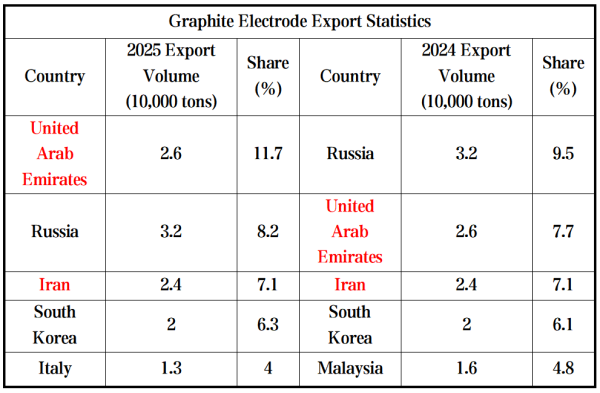
Iran and the United Arab Emirates are important export destinations for Chinese graphite electrodes. From 2024 to 2025, exports to Iran accounted for more than 7% of China's total graphite electrode exports, while exports to the United Arab Emirates accounted for about 10%. After the escalation of the U.S.–Iran conflict and the closure of the Strait of Hormuz, exports to these two markets have been significantly affected. Based on export volumes in March 2025, the estimated affected export volume is about 6,000 tons. This portion of blocked export cargo may be forced back into the domestic market, increasing competitive pressure in the domestic market.
IV. Conclusion
Overall, this conflict has brought the following chain reactions to China's graphite electrode market:
1. Rising Production Costs
The conflict has triggered market concerns about raw material supply, driving expectations of rising prices for upstream raw materials such as petroleum coke and providing cost-side support for graphite electrode prices. Meanwhile, near-complete suspension of port vessel traffic has also increased logistics costs.
2. Export Pressure Shifting to the Domestic Market
Based on export volumes in previous years, several thousand tons of graphite electrodes that were originally destined for the Middle East will be difficult to deliver in the short term. This supply may be forced back into the domestic market, potentially intensifying competition in the domestic market.
3. Accelerating Industry Differentiation
With increasing external uncertainties, enterprises with complete industrial chain layouts—such as certain leading companies that benefit from raw material self-sufficiency and stable supply capabilities—may demonstrate stronger risk resistance and benefit during industry restructuring. In contrast, smaller enterprises that rely heavily on exports may suffer significant losses and be forced to develop alternative overseas markets such as Russia and South Korea.
Overall, the Iran conflict has created immediate pressure on China's graphite electrode exports due to logistics disruptions in the short term, while in the long run it may also have a broader impact on the domestic market. This situation forces the entire graphite electrode industry to prepare countermeasures for the risks ahead, both in export and domestic markets, and will undoubtedly serve as a test of enterprises' resilience and risk management capabilities.
Feel free to contact us anytime for more information about the Graphite Electrode market. Our team is dedicated to providing you with in-depth insights and customized assistance based on your needs. Whether you have questions about product specifications, market trends, or pricing, we are here to help.
No related results found




0 Replies