




【Insight Sharing】Analysis of Needle Coke Calcination Equipment

Graphite electrodes are the essential consumables in EAF steelmaking. Due to their outstanding electrical conductivity and excellent high-temperature resistance, they play a critical role in ensuring efficient and stable furnace operation, thereby improving steel production capacity and product quality.
【Insight Sharing】Analysis of Needle Coke Calcination Equipment
Abstract
Needle coke is a high-quality carbon material used for producing high-power and ultra-high-power electrodes. Before 2008, it relied entirely on imports. In recent years, with the deepening of research on needle coke, China has gradually established several production units of different scales. Although the quality of domestic needle coke has approached or even reached the level of overseas products, due to various reasons, the scale and continuity of needle coke production have been constrained to different extents, among which calcination equipment is one of the key factors.
The process of heat-treating carbonaceous raw materials at high temperatures to remove volatile components and improve their physical and chemical properties is called calcination. The purposes of calcination are: to remove moisture and volatile matter; to increase density and mechanical strength; to improve electrical conductivity; and to enhance chemical stability and oxidation resistance. Calcination is a critical process in needle coke production, and the quality of calcined coke directly affects the quality of electrode products. Therefore, the selection of calcination equipment is particularly important for needle coke production.
Differences Between Needle Coke and Petroleum Coke Calcination Equipment
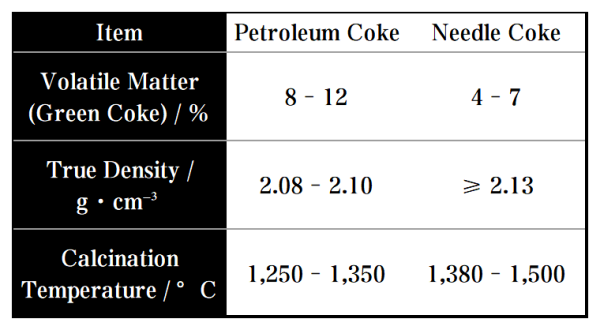
At present, calcination equipment in China is generally designed for petroleum coke, including rotary kilns, shaft (pot) furnaces, and rotary hearth furnaces. Compared with petroleum coke, needle coke calcination has certain particularities, as shown in the following table. Therefore, these calcination equipment types have various limitations and incompatibilities when applied to needle coke calcination.
Analysis of Several Calcination Equipment Types
Rotary Kiln
The basic function of a rotary kiln is to provide sufficient heat to bring petroleum coke to the required reaction temperature and to ensure effective mixing of granular or slurry materials so that they are heated uniformly inside the kiln. During the calcination process, moisture and volatiles are separated, resulting in carbon with an appropriate structure. About 60% of carbon plants and aluminum plants in China use rotary kilns as calcination equipment. The advantages of rotary kilns include low construction cost, large production capacity, simple operation, high automation level, strong adaptability, single material composition, and simple structure.
As a calcination device for needle coke, rotary kilns have been used in Japan since the 1980s and are still in use today. Several needle coke units built in China also adopt rotary kilns. The process flow is as follows: materials are conveyed by belt conveyors into the kiln tail through a chute, gradually move toward the kiln head as the kiln rotates, and after calcination, the materials are discharged into a cooler and then transported to the finished product warehouse. The process flow diagram is shown in Figure 1.
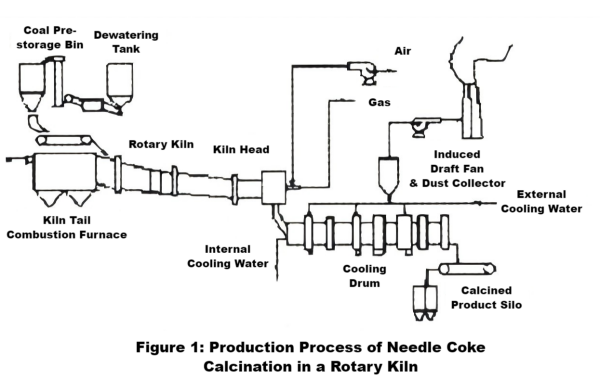
When calcining needle coke in a rotary kiln, the internal temperature distribution is generally divided into three zones: preheating zone, calcination zone, and cooling zone. The calcination zone temperature can reach up to 1500°C. In addition to the aforementioned advantages, another key benefit is the effective removal of sulfur impurities from green coke. It has been reported that sulfur-containing compounds such as thiophenes in green coke break their carbon-sulfur bonds above 1200°C, allowing sulfur to escape significantly. The removal of sulfur greatly improves the quality of needle coke products, enhances the yield of graphite products, and avoids contamination in subsequent processes—advantages that other calcination equipment cannot achieve.
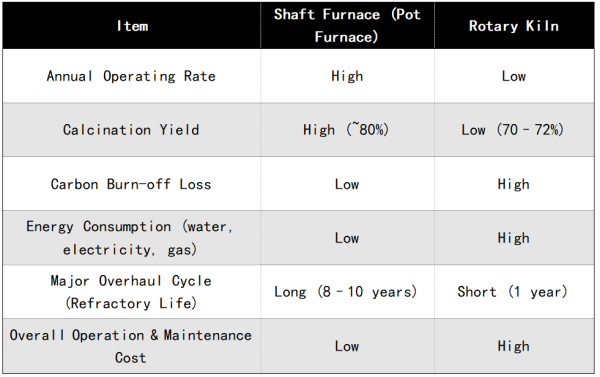
However, due to the high temperature required in the calcination zone and the relatively low volatile content of needle coke green coke (around 6%), a large amount of external fuel is needed to meet heat requirements. This increases carbon burn-off and results in significant material loss, leading to a relatively low calcination yield of only 70%–72%.
In addition, since the rotary kiln is a rotating device operating at high temperatures, it poses significant challenges to refractory material performance and lining construction. Although modern refractories have high softening temperatures under load and perform well in blast furnaces and other high-temperature equipment, their performance in rotary kilns for needle coke calcination has been less satisfactory. In China, two operating needle coke plants using rotary kilns have faced refractory-related issues, with continuous operation lasting less than one year, and in some cases only one to two months before problems arose, forcing production reduction or shutdown and severely restricting production continuity.
Moreover, during operation, some of the castable lining inside the kiln may fall off and mix into the needle coke, increasing ash content and reducing product quality, which negatively affects subsequent graphite products. Additionally, rotary kilns are not well suited for fine particles in green needle coke. Fine particles are lifted repeatedly and exposed to air, increasing carbon burn-off and disrupting the internal atmosphere and temperature distribution. At the kiln head, some fine particles fail to enter the cooler and instead accumulate and undergo secondary combustion, causing "backfire," posing safety risks and operational difficulties.
Shaft (Pot) Furnace
The shaft calcining furnace is an early-developed calcination device in China, accounting for about 37% of calcination equipment in carbon and aluminum plants. Based on the direction of material movement and heat flow, shaft furnaces are classified into co-current and counter-current types.
As a calcination device for needle coke, shaft furnaces were first applied in China at Anshan Coastal Chemical Plant in Liaoning Province. The furnace type used was a 24-pot, 8-flue-layer design, with two units put into operation in 1994. The flue temperature ranged from 1380 to 1400°C, and the residence time of needle coke exceeded 24 hours. The true density of calcined coke reached ≥2.129 g/cm³.
In 2010, Shijiazhuang Deli Chemical Co., Ltd. built a 24-pot, 10-flue-layer co-current shaft furnace to calcine coal-based needle coke, designed for an annual output of 15,000 tons. The purpose of the 10-layer flue design was to increase calcination temperature. However, due to various reasons, the furnace temperature failed to reach the desired level. Oil was added before calcination to increase heat supply, but temperature control remained unstable. Manual discharge caused localized damage to some pots and flues, leading to partial shutdown. Ultimately, only part of the calcined coke reached a true density of 2.139 g/cm³, while other indicators were not specified.
In terms of process, unlike rotary kilns, materials in shaft furnaces do not directly contact high-temperature flames and move slowly inside the furnace. Therefore, carbon burn-off is low, and physical loss of fine coke particles is minimal, resulting in better product quality. Heat is transferred by radiation through flues, removing moisture and volatiles and improving thermal stability and physicochemical properties. Shaft furnaces are also suitable for fine particle raw materials.
However, since the maximum calcination temperature is 1250–1350°C, sulfur removal is limited. Due to the low volatile content of needle coke, external fuel gas is required. The level of automation in shaft furnaces is relatively low, and manual control often leads to delayed adjustments and poor control at measurement points, causing local overheating and damage, affecting production. Strict raw material sizing is also required. Excess large particles may cause smoking and flaming at the furnace top, significantly affecting furnace life. The advantages and disadvantages of shaft furnaces compared with rotary kilns are shown in the following table.
Rotary Hearth Furnace
Rotary hearth calcination technology has been used overseas for many years. In 1995, Jinzhou Petrochemical introduced a rotary hearth calcination furnace with a diameter of 17.5 meters, designed by Shenyang Aluminum & Magnesium Design Institute. It was successfully installed and commissioned, producing qualified calcined petroleum coke and needle coke. The capacity was 21.0 t/h for petroleum coke and 13.0 t/h for needle coke. This remains the only rotary hearth calcination unit in China.
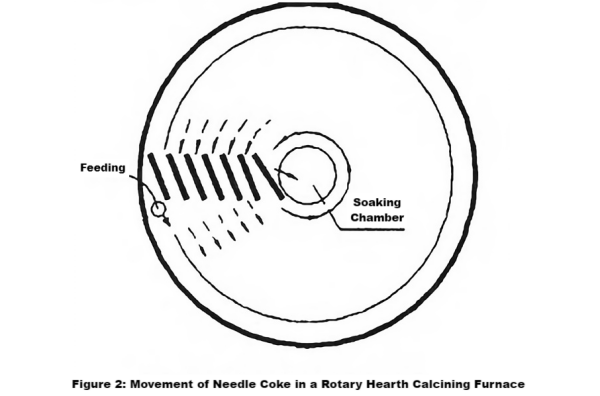
However, due to strict temperature control requirements and high calcination temperatures, the overall thermal load is significantly increased, which is unfavorable for stable operation. It also increases energy consumption and material loss. In addition, rotary hearth furnaces require high capital investment, have complex structures, and incur high maintenance costs, making them less advantageous. Therefore, they have not been widely adopted in China. The movement of needle coke in a rotary hearth furnace is shown in Figure 2.
Development Direction of Needle Coke Calcination Equipment and Process
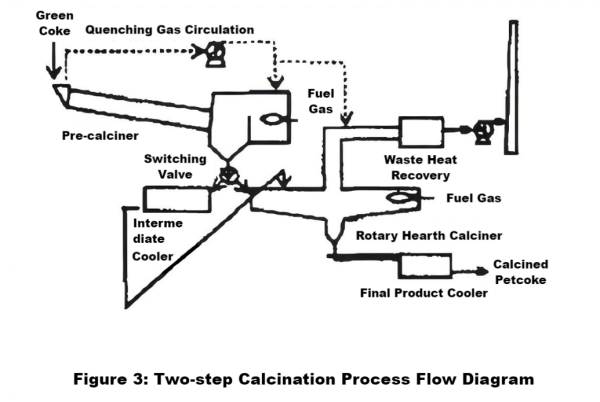
Each of the above calcination equipment types has its own advantages and disadvantages. Future development should focus on leveraging strengths while mitigating weaknesses, and hybrid utilization of different equipment types can be considered. As early as the late 1980s, researchers I. Lindhout, R. S. Downing, and F. J. A. Geiger studied a two-step calcination process (Figure 3): pre-calcination using a small rotary kiln followed by further calcination in a rotary hearth furnace.
This process improves coke quality and enhances equipment efficiency. However, it requires high capital investment, and the high calcination temperatures can damage equipment, leading to high maintenance costs and difficulty in long-term stable operation. Therefore, it has not developed rapidly over the past decades.
Based on the above, combined with China's production and technical conditions, it is recommended to classify green coke by particle size before calcination. Literature reports that particles smaller than 7 mm are almost completely burned during rotary kiln calcination. Field observations also show that particles smaller than 5 mm are often drawn into dust chambers due to negative pressure and burned there, significantly reducing yield.
By adopting pre-classification, different calcination equipment can be used for different particle sizes: fine particles for shaft furnaces and larger particles for rotary kilns. This approach improves calcination yield and facilitates product classification according to application requirements.
In terms of equipment, a combination of rotary kilns and shaft furnaces is recommended to leverage their respective advantages. Rotary kilns are less suitable for fine particles and suffer from high carbon loss, resulting in lower yield, but they offer advantages in scalability, low investment, small footprint, and high automation. Shaft furnaces are suitable for fine particles, with low carbon loss and high yield, but have higher investment costs and more complex operation.
Conclusion
Although domestic production of needle coke has been achieved, its large-scale and continuous production remains unsatisfactory due to limitations such as calcination equipment. Therefore, it is necessary for industry professionals to continue addressing existing issues, such as refractory selection and lining methods for rotary kilns, as well as the scaling and automation of shaft furnaces. Meanwhile, research and development of new calcination processes for needle coke should not be interrupted.
Feel free to contact us anytime for more information about the Needle Coke market. Our team is dedicated to providing you with in-depth insights and customized assistance based on your needs. Whether you have questions about product specifications, market trends, or pricing, we are here to help.
No related results found




0 Replies