




【Steel】Up RMB 200! Leading steel mills send a signal! Steel prices may rise in April!

Graphite electrodes are the essential consumables in EAF steelmaking. Due to their outstanding electrical conductivity and excellent high-temperature resistance, they play a critical role in ensuring efficient and stable furnace operation, thereby improving steel production capacity and product quality.
【Steel】Up RMB 200! Leading steel mills send a signal! Steel prices may rise in April!
According to the survey and release by the China Federation of Logistics & Purchasing (CFLP) Steel Logistics Professional Committee, the steel industry PMI stood at 50.6% in March 2026, up 3.9 percentage points month-on-month. After remaining below 50% for seven consecutive months, it returned to the expansion range, indicating that as the impact of the Spring Festival gradually faded, the steel industry has resumed a positive operating trend and overall sentiment has improved.
With April arriving, as the opening year of the 15th Five-Year Plan, the month for verifying market demand has also come. Previously, four major northern steel enterprises—Angang Steel, Benxi Steel Plate, Lingyuan Steel, and Shougang—successively released their April 2026 ex-factory pricing policies, all raising steel product prices based on March levels. Core product prices were uniformly increased by RMB 200/t, with only slight differences among certain sub-categories, showing a highly consistent pricing adjustment. In addition, the first round of coke price increases will be implemented today. Will the expected upward trend materialize in April? Let's take a closer look:
Review of Steel Prices in March
Taking Tangshan billet prices as an example, steel prices in March showed an overall fluctuating trend, ranging between RMB 2,910–2,990/t throughout the month, with a maximum amplitude of RMB 80/t.
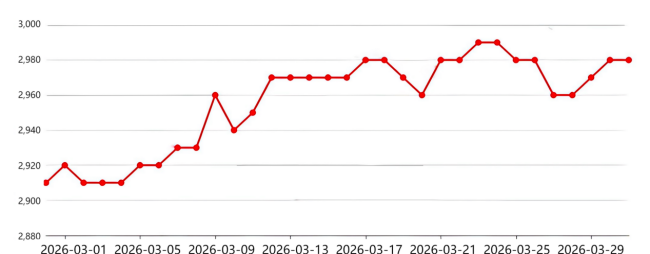
Steel prices demonstrated resilience in March, mainly driven by strong cost support and geopolitical conflicts. On one hand, cost support remained strong. After multiple rounds of price cuts, coke producers suffered severe losses and showed strong willingness to hold prices firm. On the other hand, geopolitical conflicts pushed up international energy and shipping costs, keeping imported iron ore prices high. Meanwhile, steel mill profits remained at marginal levels, which to some extent limited the downside of prices. Overall, steel prices in March stabilized amid the tug-of-war between costs and demand, leaving the real directional choice to April.
Steel Mill Profitability
Survey data shows that steel mill profitability gradually improved in March. Profitability rose from 38.1% at the beginning of the month to 43.29% by the end of the month. Profit conditions improved, with per-ton steel profits hovering around the break-even point and slightly improving by month-end.
Data from the National Bureau of Statistics shows that the steel industry recorded a net loss of RMB 2.47 billion in January–February, an increase in losses of RMB 920 million year-on-year, making it the only loss-making industry. During January–February, the average loss per ton of steel in China was RMB 15, turning from profit at the end of last year to loss, and increasing losses by RMB 6 compared to the same period last year.
Currently, 11 listed steel companies have disclosed their 2025 results, with six reporting profits. CITIC Special Steel ranked first with a net profit of RMB 5.929 billion, followed by Nanjing Iron & Steel at RMB 2.867 billion, and Hunan Valin Steel at RMB 2.611 billion. Fangda Special Steel achieved a net profit of RMB 942 million, up 280.18% year-on-year.
Despite the severe steel market conditions in 2025, leading listed steel enterprises such as CITIC Special Steel and Nanjing Iron & Steel achieved net profits exceeding RMB 2.5 billion, while Fangda Special Steel's net profit surged by 280% year-on-year. Although the steel industry remained the only loss-making sector in January–February, profitability recovered to 43.29% in March.
This indicates that under overall pressure, leading enterprises have demonstrated strong risk resistance through advantages in product structure and cost control, and industry profitability is gradually stabilizing and recovering.
Analysis of Bullish and Bearish Factors for April Steel Prices
Bullish Factors
1. Further strengthening of cost support
On April 1, the first round of coke price increases was implemented, rising by RMB 50–55/t, directly pushing up steel production costs. The market generally expects another 1–2 rounds of increases. Meanwhile, iron ore prices remain high, with the Platts 62% index holding above USD 110, and freight rates continuing to rise. Cost support for steel prices is shifting from a floor to an upward driver.
2. Strong price support from leading steel mills
Leading mills such as Baowu, Angang, and Shougang have generally raised April ex-factory prices by RMB 200/t. The willingness of mills to increase prices significantly during the traditional peak season sends two signals: first, steel mills have sufficient orders and extended production schedules; second, they hold strong confidence in demand recovery in April. Historically, pricing by leading mills has strong guiding effects, and spot market prices are likely to follow.
3. Accelerated inventory destocking
Since late March, both social inventory and mill inventory of steel products have entered a downward trend. Data shows that rebar social inventory has declined for three consecutive weeks, with an expanding rate of decline. Hot-rolled coil inventory is also being reduced faster, and inventory pressure in major consumption regions such as East China and South China has eased significantly. Under low inventory conditions, market sensitivity to price fluctuations increases.
4. Expectation gap in demand
Although demand recovery in March was relatively slow, the market still holds expectations for April. On one hand, April is the traditional peak construction season, and with rising temperatures and improved fund availability, demand for construction steel may be released in a concentrated manner. On the other hand, the manufacturing sector continues to recover, with strong orders in industries such as automobiles, home appliances, and shipbuilding, supporting demand for flat steel products. If demand exceeds expectations, steel prices will have a solid basis for upward movement.
Bearish Factors
1. Real estate still at the bottoming stage
Although policy support continues, new construction starts and construction area in real estate remain in negative growth year-on-year. The availability of funds and project commencement rates are weaker than in previous years. This suggests that the demand elasticity for construction steel may be lower than expected, and the peak season performance of rebar still needs to be observed.
2. Uncertainty from geopolitical conflicts
The spread of conflict in the Middle East to industrial facilities has driven up energy prices and shipping costs, which supports steel prices. However, it may also trigger increased global risk aversion and heightened commodity price volatility. If the situation worsens further, it could impact export orders. As the Gulf countries are important export destinations for Chinese steel, disruptions to industrial facilities or port operations could pose risks to an export market of approximately 13 million tons.
3. High inventory structure pressure
Although total inventory is declining, it remains high year-on-year. Taking Tangshan billet as an example, warehouse and port inventories exceed 2.5 million tons, nearly 1.5 million tons higher than the same period last year. This high inventory structure means that once prices rise, traders' willingness to cash out will increase, which may cap the upside.
Latest Outlook for April Steel Prices
Overall, steel prices in April are likely to show a fluctuating upward trend, but the extent and pace of the increase will depend on the realization of demand.
In early April, with the implementation of coke price increases and higher guidance prices from leading steel mills, market sentiment is expected to improve, and prices may see a tentative rise. In mid-to-late April, as demand enters the verification phase, if end-user procurement increases, price gains will gain solid support; if demand falls short of expectations, prices may shift to high-level fluctuations.
In terms of product categories, flat products may outperform long products. For rebar, actual construction activity in April needs to be observed. If the rate of fund availability improves significantly, construction steel also has the potential for a catch-up increase.
For market participants, April may be a "window of opportunity," but it should be noted that the steel market is still in a game between weak current fundamentals and strong expectations. Caution is advised when chasing high prices, while opportunities may exist for positioning at lower levels.
Feel free to contact us anytime for more information about the EAF Steel market. Our team is dedicated to providing you with in-depth insights and customized assistance based on your needs. Whether you have questions about product specifications, market trends, or pricing, we are here to help.
No related results found




0 Replies