




【Recarburizer Selection Guide】Key Properties and Performance Evaluation

【Recarburizer Selection Guide】Key Properties and Performance Evaluation
(I) Performance Indicators
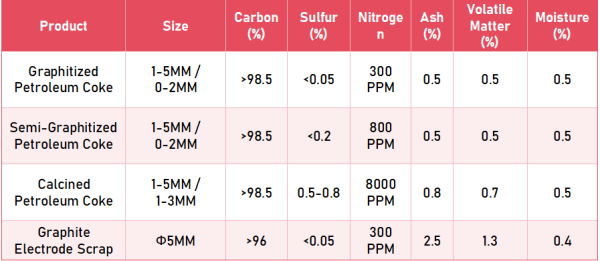
Fixed carbon content, ash content, particle size, and other factors affect the carbon absorption rate, while sulfur, nitrogen content, volatile matter, and moisture can directly cause casting defects.
Particle Size Distribution
The particle size distribution of graphitized recarburizers can be tested using a laser particle size analyzer to determine the proportion of different particle size ranges, average particle size, maximum particle size, etc.
The particle size of recarburizers should be selected according to different melting methods, furnace types, and furnace sizes.
For example, for induction furnaces, the suitable particle size is generally 0.2-6mm, while for steel and other ferrous metals the particle size is 1.4-9.5mm. High-carbon steel requires low nitrogen content, with particle size generally at 0.5-5mm. Specific selection should be based on detailed conditions such as furnace type and casting products.
In addition, attention should be paid to uniform particle size distribution. Uneven particles are one of the reasons for poor absorption performance. To improve carburization efficiency, recarburizers should undergo particle size treatment to remove excessive fine powder and oversized particles.
Moisture Content
The total moisture content of recarburizers should be kept as low as possible. Moisture introduced into molten steel will increase the hydrogen content in the melt. Total moisture depends on quenching process, storage, and transportation conditions.
For small bag packaged recarburizers, moisture content should be ≤1%, while raw coke before crushing and packaging should have moisture ≤3%.
Ash Content and Fixed Carbon Content
The fixed carbon in recarburizers is the truly useful component, and the higher the value, the better. Fixed carbon cannot be directly measured and is calculated indirectly. The lower the ash and volatile matter content, the higher the fixed carbon content.
Fixed carbon and ash content are two opposing parameters in recarburizers and are also the two most important factors affecting carburization efficiency. High fixed carbon and low ash content result in high carburization efficiency, while the opposite leads to lower efficiency.
Recarburizers with high ash content tend to form slag layers through “coking,” which isolate carbon particles and prevent dissolution, thereby reducing carbon absorption efficiency. High ash content also increases slag volume, prolongs operation time, increases electricity consumption, and raises labor intensity during smelting.
When using channel induction furnaces, low-ash recarburizers should especially be selected to avoid oxide accumulation in the channel, which may affect electrical efficiency.
The ash content varies greatly among different types of recarburizers. Graphite recarburizers generally have low ash content, approximately 0.5-1.0%, while calcined anthracite has relatively high ash content, with even high-quality products typically not lower than 4-5%.
From the perspective of carburization efficiency, higher fixed carbon and lower ash content are desirable, but production costs and the impact on molten iron quality must also be considered.
Volatile Matter Content
Volatile matter is an ineffective component in recarburizers. Volatile matter entering molten steel increases gas content in molten iron and raises the risk of porosity defects in castings. Volatile matter depends on the calcination or coking temperature and processing method of the recarburizer. Properly processed recarburizers generally have volatile matter below 0.5%. Therefore, anthracite coal and raw petroleum coke are not suitable as recarburizers.
Calcined anthracite, calcined petroleum coke, and artificial graphite all undergo high-temperature treatment, resulting in very low volatile matter and moisture content, so these indicators are generally not tested or emphasized.
Sulfur Content
Sulfur in recarburizers is an important harmful element that reduces steel ductility and toughness, and therefore the lower the value, the better. Sulfur content depends on the sulfur content of the raw materials and the calcination temperature.
Sulfur is a harmful element that interferes with spheroidization. Generally, for ductile iron production, the sulfur content in molten iron is required to be S≤0.015%; therefore, recarburizers for ductile iron should have as low sulfur content as possible.
For gray iron, in order to ensure inoculation performance, molten iron sulfur content is generally required to be 0.06-0.12%, so recarburizers for gray iron are allowed to have relatively higher sulfur content.
Nitrogen Content
The effect of nitrogen content in recarburizers on gray iron has both positive and negative aspects. Generally, when nitrogen content is 70-120ppm, nitrogen stabilizes pearlite, causes flake graphite to bend and blunt its tips, thereby improving the mechanical properties of gray iron.
However, when nitrogen content in gray iron exceeds the equilibrium concentration (generally considered about 140ppm), crack-like nitrogen porosity defects may occur in castings. Therefore, selecting a suitable nitrogen content is critical in recarburizer selection.
Generally, gray iron mainly uses coal-based or petroleum coke recarburizers, with nitrogen content around 1000ppm sufficient for most casting material requirements.
For ductile iron production, graphite recarburizers or graphitized recarburizers are required.
(II) Selection of Recarburizers
Poor-quality recarburizers can cause significant losses to enterprises, including slow absorption, low absorption rate, increased costs, unnecessary waste, and harmful elements affecting product quality.
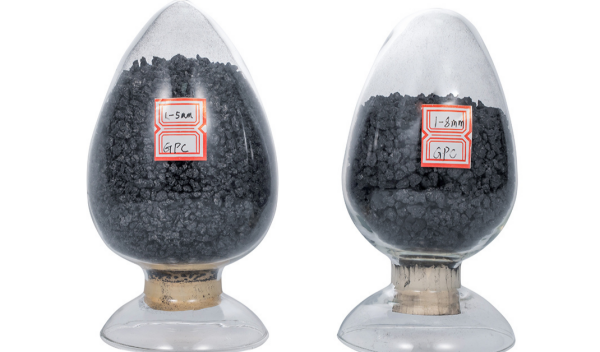
High-temperature fully graphitized low-sulfur recarburizers have low sulfur and nitrogen content, which can effectively prevent nitrogen porosity. They perform well in high-end castings requiring strict sulfur and nitrogen control. They also feature high absorption rates, low impurities, and stable composition. With proper usage, the absorption rate can reach approximately 95%.
Medium-temperature graphitized recarburizers offer relatively high cost performance and can be used in ordinary ductile iron and gray iron melting processes. With proper usage, the absorption rate can reach ≥90%.
Semi-graphitized recarburizers are mainly used in gray iron castings and can also be applied in ordinary ductile iron products with relatively low recarburizer addition ratios. During melting, they should preferably be added before the molten iron reaches two-thirds melted. With proper usage, the absorption rate can reach ≥90%.
High-sulfur recarburizers belong to non-graphitized recarburizers and are not treated at high temperatures during production. Compared with graphitized recarburizers, they have higher sulfur and nitrogen content. They are more suitable for gray iron products and can reduce the addition amount of ferrosulfur. The absorption rate of this type of recarburizer is generally between 85%-90%, with relatively slow melting and absorption speed, making them unsuitable for addition during the later stages of molten iron melting.
Feel free to contact us anytime for more information about the Recarburizers market. Our team is dedicated to providing you with in-depth insights and customized assistance based on your needs. Whether you have questions about product specifications, market trends, or pricing, we are here to help.
No related results found




0 Replies