




【Steel】The "Export Buy-Order" Frenzy Comes to an End: A Three-Way Game of ...

Graphite electrodes are the "lifeline" of EAF steelmaking! As the core material for arc conduction and heating, they feature high conductivity and heat resistance, directly affecting molten steel quality and output. Mastering graphite electrodes means mastering the initiative in EAF steelmaking!
【Steel】The "Export Buy-Order" Frenzy Comes to an End: A Three-Way Game of Political Performance, Corporate Profits, and the National Tax Base
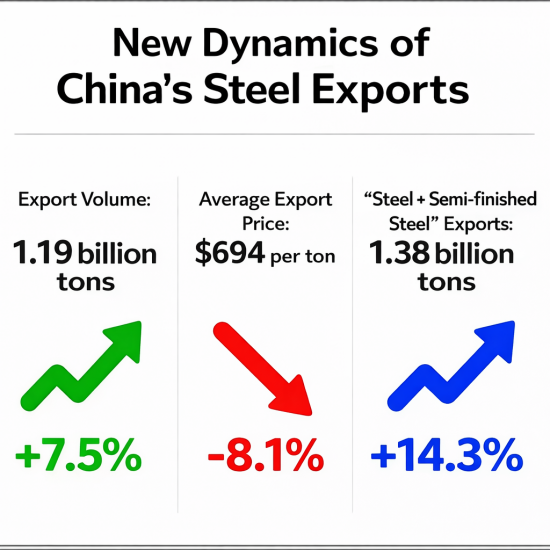
In 2025, China's steel exports reached a new record high—119 million tons, up 7.5% year-on-year. Yet few noticed that the average export price fell by 8.1% YoY to just USD 694 per ton. Even more alarming, exports of "steel products + billets," converted into crude steel equivalent, surged to 138 million tons, representing a 14.3% increase.
Volumes are rising, but revenue is not. Behind this anomaly lies a gray industrial chain: "buy-order exports" of steel.
This is not a conventional foreign trade practice, but a carefully engineered numbers game. Shell companies with no real operations purchase the export data of genuine cargo owners and "graft" these figures into the customs system to fabricate export performance, thereby fraudulently obtaining local government subsidies. At the same time, steel producers evade the 13% value-added tax (VAT), while freight forwarders profit from issuing invoices. Multiple parties carve up the national tax base—while the ultimate cost is borne by the long-term health of China's steel industry and the security of public finances.
I. How Do "Buy-Order Exports" Operate? A Tightly Interlocked Chain of Interests
In 2021, China canceled steel export tax rebates in an effort to curb the spillover of low-end capacity and promote high-quality industry development. However, the policy intent was distorted.
At the time, tax and customs data systems were not fully integrated. Some traders and steel companies quickly identified loopholes: no invoicing, no tax declaration, no rebate application. Steel products were sold directly to unqualified intermediaries, who then exported the goods under the name of companies holding export qualifications.
This is the core logic of "buy-order exports":
■ Steel producers: save 13% VAT and can also sell surplus input VAT invoices to other companies for tax offsets;
■ Traders / freight forwarders: fabricate contracts and falsify documents, charge "buy-order fees," and rapidly register and deregister shell companies;
■ Local governments: in order to meet export performance targets, tacitly allow or even encourage companies to "purchase data," granting subsidies at a rate of RMB 0.03 per USD 1 of exports;
■ Actual cargo owners: focus only on getting goods shipped overseas, indifferent to whose company name is used for customs declaration.
Thus, a closed loop of "export data → fiscal subsidies → tax evasion arbitrage" is formed. According to disclosures, a single case in an inland province involved over RMB 100 million, while another case in Southwest China exceeded RMB 200 million. These "exports" never physically occurred in the local regions, yet they were counted toward local political achievements, consumed fiscal funds, and contributed nothing to local employment, taxation, or industrial development.
II. "Collusion" Driven by Political Performance: Who Is Enabling This Game?
What is most troubling is not corporate profit-seeking, but the ambiguous—and in some cases leading—role of local commerce authorities.
Multiple cases reveal that officials from commerce bureaus proactively solicited companies for "data," saying: "We have general trade export quota targets—can you help the district meet them?" In some instances, officials even coordinated customs declaration schedules via WeChat to ensure a year-end "strong start."
When tax authorities issued risk warning letters, commerce bureaus reportedly responded: "Everyone nationwide does this. It was a special period during the pandemic, so past cases should be exempted."
This ecosystem of top-down and bottom-up collusion allowed "buy-order exports" to evolve from irregular practices into unwritten rules. Companies believed they were merely "helping the government achieve performance targets," while family members argued that "the data is real, so it's not fraud."
Judicial practice varies across regions: some cases are classified as fraud, while others result in lighter sentences for providing false certification documents. This legal gray zone has become fertile ground for abusive practices.
The reality, however, is clear: total national exports did not increase. Genuine coastal exports were merely reallocated on paper to inland regions. National foreign trade gained nothing, local finances were drained, and compliant steel producers lost price competitiveness due to higher costs.
III. Regulatory Crackdown: The End of Buy-Order Exports Is Near
Since 2025, national authorities have rolled out a series of stringent regulatory measures, signaling that this multi-year "data arbitrage" game is approaching its end.
■ Joint announcement by five ministries (March 2025): strictly prohibits falsified customs declarations and fabricated export transactions; explicitly defines "fake self-operated, real agency exports" as illegal;
■ State Taxation Administration Announcement No. 17 (effective October 2025): export agency companies that fail to submit information on the true principal will be deemed self-operated exporters and required to bear full corporate income tax liabilities;
■ From 2026 onward: the Ministry of Commerce and the General Administration of Customs will reinstate the export licensing system for 300 steel products, covering the entire chain from billets to finished products.
Article 4 of the Announcement clearly stipulates that before declaring the export of taxable goods to customs, taxpayers must complete registration information verification with tax authorities via the electronic tax system or tax service halls. Taxpayers that fail to complete verification, or that are deregistered, abnormal, or missing (uncontactable), must resolve all tax-related issues before customs procedures can be processed.
Article 5 further stipulates that before applying for deregistration with market supervision authorities, exporters of taxable goods must first complete tax deregistration and obtain a tax clearance certificate.
This means:
✅ Shell companies can no longer easily deregister and disappear;
✅ Freight forwarders that conceal the true exporter will face substantial tax liabilities;
✅Export costs for low value-added steel products will rise sharply, forcing a shift toward higher-end products;
✅ Local governments will find it increasingly difficult to inflate performance metrics through purchased data.
The China Iron and Steel Association stated explicitly that these measures aim to "prioritize domestic demand and maintain global trade balance," and to promote the industry’s transition from "volume-driven pricing" to "quality-based pricing."
IV. Reflection: What Kind of Foreign Trade Growth Do We Really Need?
The rise and fall of buy-order exports expose a deeper issue: when performance evaluation relies solely on GDP and export figures, grassroots governance can easily slide into formalism—or even illegality.
True foreign trade competitiveness should not be built on fiscal subsidies or tax loopholes, but on technological innovation, green transformation, and brand value. Today, some leading steel producers have begun exporting "green steel," implementing full-process carbon audits, reducing carbon emissions per ton of steel by 50%, and obtaining international EPD certification—this is the real passport for future exports.
On January 1, 2026, the first batch of steel products applying for licenses under the new rules will clear customs. This is not merely a policy milestone, but a turning point for the industry. Companies that still hope to survive through shortcuts may be eliminated, while those that focus on technology, carbon control, and emerging markets will enter a new cycle of high-quality growth.
Conclusion
The bubble of buy-order exports will inevitably burst.
When political performance returns to reality, profits return to compliance, and exports return to value—China's steel industry can truly stand tall and compete on the global stage.
Feel free to contact us anytime for more information about the EAF Steel market. Our team is dedicated to providing you with in-depth insights and customized assistance based on your needs. Whether you have questions about product specifications, market trends, or pricing, we are here to help.
No related results found




0 Replies