




【Steel】Outlook for China's Steel Exports in 2026 Under the Iran–U.S. Conflict

Graphite electrodes are the "lifeline" of EAF steelmaking! As the core material for arc conduction and heating, they feature high conductivity and heat resistance, directly affecting molten steel quality and output. Mastering graphite electrodes means mastering the initiative in EAF steelmaking!
【Steel】Outlook for China's Steel Exports in 2026 Under the Iran–U.S. Conflict
Overview: It is expected that China's steel exports will end their growth trend in 2026, with total steel exports likely to fall back to around 100 million tons. Among them, billet exports are expected to remain above 15–18 million tons (benefiting from Iran substitution effects and relatively fewer overseas trade barriers).
I. China's Steel Export Situation in 2025
In 2025, China's steel exports increased significantly. Steel exports reached 119.02 million tons, while imports were 6.04 million tons, resulting in net exports of 112.98 million tons, an increase of 9.07 million tons year-on-year, up 8.7%. Billet exports were 14.82 million tons, imports were 0.84 million tons, and net exports were 13.98 million tons, increasing by 9.43 million tons year-on-year, up 207%, with a remarkable increase.
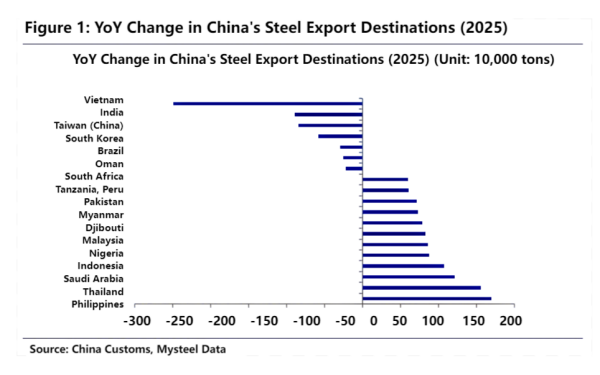
From the perspective of export destinations, in 2025, due to the increase in anti-dumping cases initiated by countries and regions such as Vietnam, South Korea, and the European Union against China, China's export destinations changed significantly. Exports to traditional markets such as Vietnam and South Korea declined notably. Among them, exports to Vietnam decreased by 2.49 million tons year-on-year, exports to India decreased by 890,000 tons, and exports to South Korea decreased by 580,000 tons.
Meanwhile, China's exports to other Southeast Asian countries, as well as Africa and the Middle East, increased significantly. Among them, exports to the Philippines increased by 1.7 million tons year-on-year, exports to Thailand increased by 1.56 million tons, and exports to Saudi Arabia and Pakistan increased by 1.22 million tons and 720,000 tons respectively.
II. Multiple Challenges Facing China's Steel Exports in 2026
(1) Export Licensing System Will Slow Export Growth
1) Slower Export Pace
Companies are required to add new procedures for license applications, including preparing export contracts and product quality inspection certificates. The process takes 1–2 weeks, leading to extended delivery times for some exporters. In the short term, steel export growth may experience a phased slowdown. From January to February, China's cumulative steel exports were 15.59 million tons, down 8% year-on-year, indicating clear pressure at the start of the year.
2) Profit Pressure and Reduced Willingness to Take Orders
The additional labor and time costs of license applications may lead companies to abandon some low-margin orders due to high compliance costs, especially impacting small and medium-sized steel enterprises that rely on intermediary export channels.
(2) Trade Frictions and RMB Appreciation Increase Export Costs
Since 2023, global anti-dumping cases against Chinese steel have surged in both number and scope. A total of 143 cases were filed during 2024–2025, and 2026 will see a peak period for final rulings. The products involved mainly include cold-rolled coils, hot-rolled coils, galvanized wire rods, seamless pipes, pre-painted sheets, and rebar, covering markets in Southeast Asia, South America, the Middle East, and Europe.
Since April 2025, the RMB has shown a continuous appreciation trend. As of March 17, the RMB exchange rate stood at 6.8892. Although recent geopolitical tensions in the Middle East have pushed the U.S. dollar index back above the 100 mark after nearly four months, with the dollar appreciating by more than 2.5%, the RMB has demonstrated strong resilience. The steel industry itself operates on thin margins (especially for long products), with net profit margins typically between 2%–5%. RMB appreciation has already created significant financial pressure for export enterprises.
(3) Iran–U.S. Conflict Disrupts Steel Exports to the Middle East
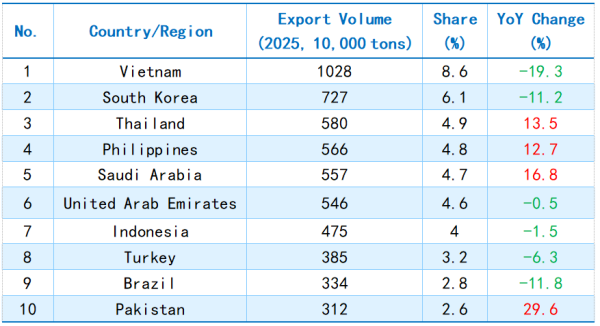
China exports approximately 24.11 million tons of steel to the Middle East, accounting for 15.6% of total steel exports. Among them, exports to the seven Gulf countries (Iran, Saudi Arabia, UAE, Iraq, Kuwait, Qatar, Bahrain) reached 13.9497 million tons, accounting for 91.3% of exports to the Middle East and 11.72% of China's total exports. The core export markets in the region are Saudi Arabia and the UAE, with a combined annual export volume of 11 million tons.
Table 1: Major Markets for China's Steel Exports (Unit: 10,000 tons, %)
Source: China Customs, Mysteel Data
Due to the escalation of the Iran–U.S. conflict, China's steel export market has entered a state of quotation stagnation. Shipping companies are unable to provide stable freight rates and vessel space guarantees, leading to widespread risks of delays or defaults for orders scheduled from April onward. Middle Eastern buyers have suspended inquiries, and Chinese exporters have been forced to halt quotations due to uncertainty in landed costs.
III. Potential Opportunities for China's Steel Exports
(1) Potential New Destinations
In the face of escalating trade frictions and the temporary stagnation of the Middle Eastern market, China's steel export resources may shift toward South America, Southeast Asia, and Africa to partially offset reductions in other regions.
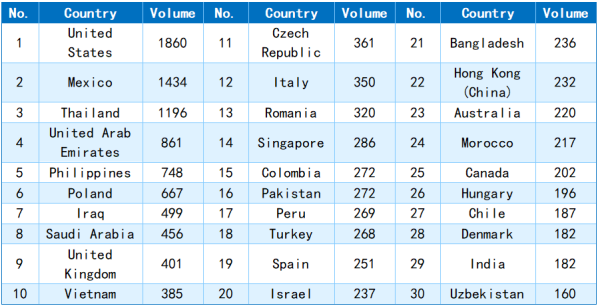
According to the World Steel Association, major net steel importing countries with volumes exceeding 10 million tons include the United States, Mexico, and Thailand; those exceeding 5 million tons include the UAE, the Philippines, and Poland. Among them, the United States imposes a 50% tariff on all imported steel and derivative products. In February, Mexico initiated anti-dumping investigations into China's seamless pipes and cold-rolled coils.
The European Union has cut its steel import quotas by nearly half, and out-of-quota tariffs have increased from 25% to 50%. Combined with the carbon costs under the EU's Carbon Border Adjustment Mechanism (CBAM), China's traditional price advantage has been weakened. Exports to EU countries such as Poland, the Czech Republic, Italy, and Romania have become more difficult.
In 2025, China's steel exports to Thailand and the Philippines increased by 13.5% and 12.7% year-on-year, respectively. These markets have relatively fewer barriers, and China's market share in these countries is expected to grow further in 2026. South American countries such as Colombia, Peru, and Chile also present certain opportunities.
In addition, there are demand gaps in South Asia and Central Asia, including Pakistan, Bangladesh, and Uzbekistan, as well as in Africa.
Table 2: Net Steel Imports of Major Countries in 2023 (Unit: 10,000 tons)
Source: World Steel Association, Mysteel Data
(2) Iran Export Substitution Opportunity
From the perspective of steel production in the Middle East, Iran is a unique major steel producer in the region, with an annual capacity of up to 55 million tons, ranking among the top ten globally. Due to the lack of coking coal resources, its steelmaking process (DRI + electric arc furnace) heavily relies on imported scrap.
The current conflict has disrupted shipping through the Strait of Hormuz, directly cutting off the lifeline for its raw material imports and finished product exports, posing a risk of production cuts. Saudi Arabia and the UAE are net steel importers, while Oman, Bahrain, and Kuwait have relatively small steel production capacities. Qatar has some production capacity but mainly serves domestic infrastructure demand, with limited exports (e.g., 580,000 tons in 2023).
From an export perspective, Iran is a net steel exporter (with 8.97 million tons of semi-finished and finished steel exports in 2023). As a traditional billet exporter (mainly to Southeast Asia), the conflict has nearly halted its exports. This not only cuts off an important source of foreign exchange but also creates opportunities for other countries (such as China) to fill the supply gap.
IV. Summary
Overall, China's steel industry will face one of the most challenging external environments in recent years in 2026.
Trade frictions may directly lead to export declines. In 2025, anti-dumping duties on Chinese hot-rolled coils imposed by Vietnam and South Korea led to a sharp reduction of 5.92 million tons in China's hot coil exports, a drop of 22%. The reductions from Vietnam, South Korea, Taiwan (China), and Egypt accounted for more than 80% of the total decline. It is estimated that in 2026, approximately 10 million tons of steel exports will be directly affected by trade barriers (including 2.7 million tons from trade remedy cases implemented in Q1, 4 million tons from EU quotas and tariffs, and volumes involved in anti-dumping cases by Brazil and Mexico in Jan–Feb 2026).
In addition, the export licensing system will curb non-compliant exports by some enterprises, while RMB depreciation will also restrain the export of certain low-end products.
There is uncertainty in the Middle East. In the short term, exports to the region are hindered by the conflict. However, the region still has strong demand potential. Saudi Arabia's "Vision 2030," along with infrastructure investment peaks in the UAE and Qatar, will drive significant demand. Future urban construction projects (such as NEOM City) will require large volumes of high-end plates and pipeline steel. If the conflict ends quickly, China's steel exports to the Middle East may rebound.
In summary, China's steel exports are expected to end their growth trend in 2026, with total exports likely to fall back to around 100 million tons. Among them, billet exports are expected to remain above 15–18 million tons (benefiting from Iran substitution effects and relatively fewer overseas trade barriers).
Feel free to contact us anytime for more information about the EAF Steel market. Our team is dedicated to providing you with in-depth insights and customized assistance based on your needs. Whether you have questions about product specifications, market trends, or pricing, we are here to help.
No related results found




0 Replies