




【Electric Arc Furnace Steel】Prices May Fluctuate Next Week

Graphite electrodes are the essential consumables in EAF steelmaking. Due to their outstanding electrical conductivity and excellent high-temperature resistance, they play a critical role in ensuring efficient and stable furnace operation, thereby improving steel production capacity and product quality.
【Electric Arc Furnace Steel】Prices May Fluctuate Next Week
From February 24 to February 27, 2026, the national average price of rebar was RMB 3,303/ton, fluctuating within a narrow range during the week. On the supply side, weekly rebar output was 1.651 million tons, with inventory at 8.006 million tons. On the demand side, apparent consumption was 335,500 tons, and there was no data available for weekly construction steel transaction volume.
◎ Core Viewpoint: Macro sentiment is warming while inventories continue to accumulate. As post-holiday market activity gradually resumes, regional supply-demand imbalances will manifest differently. Prices are expected to fluctuate, rising in some regions and falling in others next week.
This week, the rebar market exhibited relatively stable performance. On the macro level, sentiment remained supportive. Adjustments to overseas tariff policies, geopolitical developments, and the relaxation of domestic real estate policies jointly supported market sentiment, with futures prices performing relatively strongly.
However, industry fundamentals faced some pressure, reflecting a typical post-holiday pattern. Rebar output declined month-on-month due to underutilized production lines at some steel mills. Inventories continued to accumulate, though at a slower pace. Apparent consumption fell sharply week-on-week due to the Spring Festival holiday, indicating that actual demand has yet to meet expectations. Spot prices remained generally stable amid these realities.
Looking ahead to next week, the market is expected to see regional price divergence amid the interplay between macro expectations and industry fundamentals.
On one hand, inventory pressure in certain regions remains manageable, and with improving expectations, macro warmth will further support prices. Emission reduction policies ahead of key meetings and expectations surrounding the "Two Sessions" will provide psychological support to the market.
On the other hand, some regions are experiencing significant destocking pressure amid ongoing inventory accumulation, and the fundamental pressure from the industry side will gradually become more evident.
On the supply side, as independent electric arc furnace mills resume production collectively after the Lantern Festival, rebar output is set to increase with certainty. On the demand side, verification remains challenging. Although surveys by Mysteel show year-on-year improvements in construction site resumption rates and capital availability, the overall decline in newly started projects implies limited incremental steel demand, insufficient to match the pace of supply recovery, potentially leading to renewed inventory pressure.
On the cost side, iron ore port inventories remain at historically high levels, and replenishment momentum for coking coal is insufficient. If weak demand slows the pace of steel mill production resumption, raw material prices may face downward pressure, reducing cost support.
Overall, short-term rebar market direction will exhibit clear regional characteristics as fundamental factors fully unfold, leading to price divergence.
Under the dual drivers of macro expectations and industry realities, finished steel prices are constrained on both upside and downside. Different regions will display distinct adjustment logic depending on which driver dominates. Some regions with significant inventory accumulation will see price pressure, while others where inventories are about 20% lower than the same period last year may experience relatively stronger trends.
It is worth noting that while optimistic macro expectations may limit downside risk, the mismatch between weak demand recovery and rising supply, combined with high inventory digestion pressure, will constrain price performance. Caution is warranted against negative feedback risks if demand falls short of expectations.
◎ Price Observation: Futures fluctuated with a stronger bias, spot prices remained stable, and market sentiment was cautious.
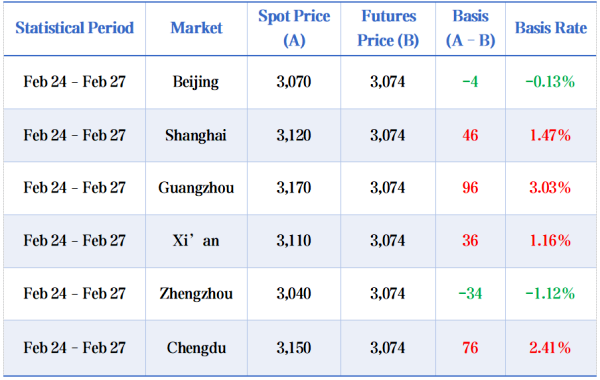
Table: Basis Between Futures and Spot Prices in Major Markets
Data Source: Mysteel
[Spot Market]
Spot prices remained relatively stable this week. As post-holiday activity is still recovering, traders maintained a wait-and-see attitude. Early in the week, inventory pressure emerged slightly, but quotations remained stable under cost support. Mid-to-late week, as macro news sentiment warmed, traders tentatively raised prices slightly. In the absence of a core driver, minor sentiment fluctuations made prices difficult to rise or fall significantly, resulting in overall stability for the week.
[Futures Market]
The futures market showed a fluctuating but stronger trend this week. Early in the week, under fundamental inventory pressure, distant-month sentiment weakened and prices fluctuated downward. Mid-to-late week, driven by autonomous production restrictions in North China and news related to the Two Sessions, macro expectations strengthened, and rebar futures trended higher in volatility. Overall, the week exhibited a "fluctuating but stronger" pattern. In terms of basis, futures traded at a discount in Shanghai, Guangzhou, Xi'an, and Chengdu, while futures traded at a premium in Beijing and Zhengzhou.
[Momentum Analysis]
Overall, the market remains cautious, as industrial recovery is still progressing. Market participants are closely watching post-Lantern Festival demand developments. Once the full picture of fundamentals emerges, regional imbalances will provide clearer feedback. The market currently faces the dual influence of forward expectations and present realities, and overall sentiment remains cautious.
◎ Data Overview
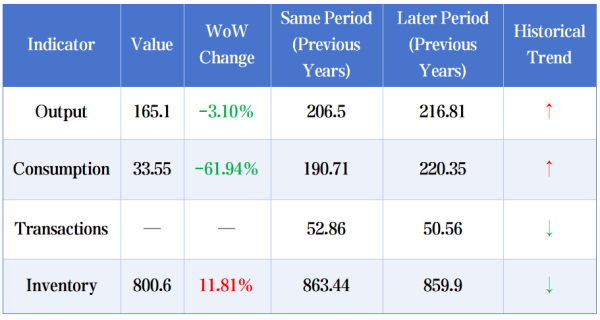
Table: Rebar Product Data Report (Unit: 10,000 tons)
Note: The trend in previous years reflects changes one week after the same period last year and is for reference only, not a forecast for the current period.
Data Source: Mysteel
Summary:
Output: During the holiday period, short-process production halted for vacations and long-process enterprises conducted annual inspections and maintenance, resulting in relatively weak supply compared to the same period in previous years.
This week, rebar output was 1.651 million tons, down 3.1% week-on-week. As enterprises gradually resume operations, output is expected to increase next week.
Demand: Currently, most downstream sectors resumed work around the Lantern Festival, but end-user demand remains slow to start, limiting market transaction activity. Weekly consumption was 335,500 tons, down 61.94% week-on-week. As post-holiday operations fully resume, incremental demand is expected, though the extent remains uncertain.
Transactions: Affected by cautious sentiment, overall transactions were moderate this week, with traders focusing on the development direction of post-holiday core demand drivers.
Inventory: Due to slow demand recovery and cautious trader sentiment, market activity remains subdued. As a result, inventories continued to accumulate, though at a slower rate. Current rebar inventory stands at 8.006 million tons, up 11.81% week-on-week. Although inventory levels remain acceptable compared to the same period in previous years, slow demand recovery and the broader industry environment still pose destocking pressure, with varying degrees across regions.
Inventories are expected to continue accumulating next week.
In summary, as market recovery progresses, supply will increase, while demand's slow recovery and ongoing inventory accumulation will exert pressure on fundamentals. However, supported by costs and expectations, downside in finished steel prices is also limited. Prices next week are expected to fluctuate depending on regional conditions.
[Market Voices]
East China Client: The market fluctuated within a narrow range this week. Supply pressure is limited, but slow demand recovery and continued inventory accumulation are weighing on price support. Prices are expected to fluctuate slightly lower next week.
Southwest China Client: The market fluctuated within a narrow range this week, with slow demand recovery. Due to low output, inventory pressure remains manageable compared to previous years. Cost support and warm macro sentiment provide limited support, but slow demand and inventory accumulation drag fundamentals in the short term. Prices are expected to fluctuate slightly lower next week.
Central South China Client: The market consolidated this week. Demand has shown slight recovery with some restocking, but slow recovery still results in inventory pressure on prices. While macro expectations have strengthened somewhat, actual demand recovery still requires time for verification. Amid this interplay, prices are expected to fluctuate within a narrow range next week.
Feel free to contact us anytime for more information about the EAF Steel market. Our team is dedicated to providing you with in-depth insights and customized assistance based on your needs. Whether you have questions about product specifications, market trends, or pricing, we are here to help.
No related results found




0 Replies