




【Recarburizer】Fully Graphitized vs Semi-Graphitized Recarburizers: How Should You Choose...

【Recarburizer】Fully Graphitized vs Semi-Graphitized Recarburizers: How Should You Choose Between High-End Castings and Cost Optimization?
When selecting recarburizers, many foundries face a critical decision: should they choose fully graphitized recarburizers or semi-graphitized recarburizers? On the surface, this appears to be a choice between product types, but in reality, it is a comprehensive consideration involving process routes, quality requirements, and cost structures. Choose correctly, and you can reduce costs while improving efficiency; choose incorrectly, and you may not only waste costs, but also introduce hidden risks into the production process.
01 Process Differences: More Than Just the Degree of Graphitization
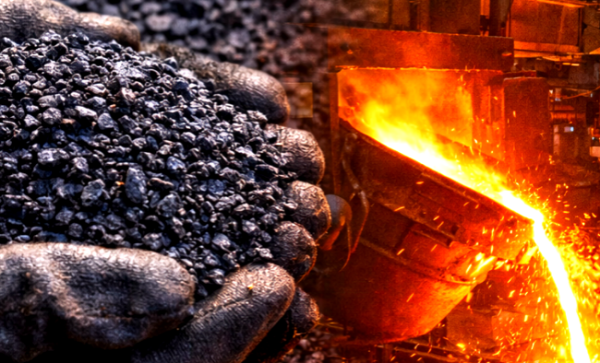
Fully graphitized recarburizers are products that undergo deep treatment in high-temperature graphitization furnaces for an extended period (typically above 2000°C). This process allows carbon atoms to arrange themselves in a highly ordered manner, forming a complete graphite crystal structure.
Semi-graphitized recarburizers, on the other hand, are processed at relatively lower temperatures (typically 1600–1800°C) for partial graphitization. Their carbon atom arrangement lies between amorphous carbon and fully developed graphite crystal structures, retaining some non-graphitized structures.
This difference in processing directly determines the fundamental distinctions between the two products in terms of both microstructure and macroscopic performance.
02 Performance Comparison: Understanding the Differences from Four Dimensions
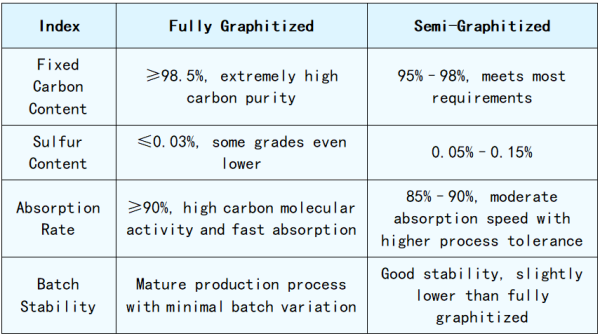
Due to their complete graphite structure, fully graphitized recarburizers exhibit extremely low burn-off rates and highly stable recarburizing performance in high-temperature melting environments. They also possess a decisive advantage in sulfur control.
Semi-graphitized recarburizers, meanwhile, offer significant advantages in production capacity and cost efficiency in large-scale standardized production scenarios.
03 Application Scenarios: Which One Is More Suitable?
Fully graphitized recarburizers are more suitable for:
High-end ductile iron production — highly sensitive to sulfur content, requiring extremely low sulfur levels to ensure nodularization performance; requiring rapid and stable carbon absorption to guarantee precise composition control. Typical applications include automotive engine components, wind power castings, high-speed railway components, and rail transit castings.
High-grade gray iron and special alloy cast iron — requiring strict control of sulfur, phosphorus, and other impurity elements, while pursuing higher mechanical performance and material purity.
Semi-graphitized recarburizers are more suitable for:
Conventional gray iron production — where there is some tolerance for sulfur content and cost sensitivity is relatively high. Typical applications include machine tool beds, pump and valve housings, and general mechanical components.
Medium- and low-grade ductile iron and synthetic cast iron processes — used together with high proportions of scrap steel to effectively control raw material costs while maintaining product quality.
04 Selection Strategy: Four Key Questions
① Question: What is the casting's tolerance for sulfur content?
Answer:
If the requirement is ≤0.02%, fully graphitized recarburizers should be prioritized;
If 0.05%–0.10% sulfur is acceptable, semi-graphitized recarburizers may be sufficient.
② Question: How sensitive is the production process to absorption speed?
Answer:
Production lines with rapid melting and frequent adjustments require faster absorption rates;
Production lines with relatively stable operating rhythms can tolerate slower absorption speeds.
③ Question: What does the quality-cost structure look like?
Answer:
For products with high quality-loss costs, investing in better materials is worthwhile;
For products where quality-related costs are relatively controllable, greater emphasis can be placed on cost efficiency.
④ Question: What is the level of process control?
Answer:
Companies with refined process control can better leverage the advantages of fully graphitized recarburizers;
Companies with relatively rough process management may be better suited to the stability of semi-graphitized recarburizers.
05 Cost Performance: More Expensive Does Not Always Mean Better
Many companies have a misconception that fully graphitized recarburizers are always superior to semi-graphitized recarburizers. In reality, as long as quality requirements are met, choosing the solution with the best cost-performance ratio is the wisest approach.
For example: if a company produces 1,000 tons of castings per month and uses recarburizers at a ratio of 3%, and the company mainly produces conventional gray iron castings with low sulfur sensitivity, then choosing fully graphitized recarburizers would be excessive investment — the additional cost would not bring corresponding value improvements.
On the other hand, if the company produces high-end ductile iron automotive castings, where excessive sulfur content could lead to nodularization failure and casting scrap, then choosing fully graphitized recarburizers becomes a necessary quality assurance measure.
Feel free to contact us anytime for more information about the Recarburizers market. Our team is dedicated to providing you with in-depth insights and customized assistance based on your needs. Whether you have questions about product specifications, market trends, or pricing, we are here to help.
No related results found




0 Replies