




【Graphite Anode】Core Processes: Graphitization and High-Temperature Carbonization

The rapid growth of the EV and energy storage industries is boosting demand for high-performance lithium batteries, driving the market for quality petroleum coke and synthetic graphite. The quality and particle size of calcined petroleum coke directly affect synthetic graphite performance, especially in anode production.
【Graphite Anode】Core Processes: Graphitization and High-Temperature Carbonization (Key Technical Insights)
Graphite Background
Graphite is currently the most widely commercialized anode material used in lithium-ion batteries. With the continuous growth of market demand, higher requirements are being placed on the lithium storage performance of graphite anode materials.
Graphite anodes offer advantages such as high specific capacity and relatively low operating voltage. However, they also have inherent drawbacks. For example, graphite shows poor compatibility with electrolytes. During charge and discharge, solvent molecules may co-intercalate with lithium ions into the graphite layers, causing layer expansion and exfoliation, which reduces battery capacity and service life. In addition, surface heterogeneity of graphite makes it difficult to form a uniform and dense SEI (solid electrolyte interphase) film during the first charge–discharge cycle, resulting in low initial coulombic efficiency and poor cycling performance. Therefore, in practical production and application, existing graphite-based anode materials often require structural regulation and surface coating modification to improve their overall performance.
01 Graphitization Process
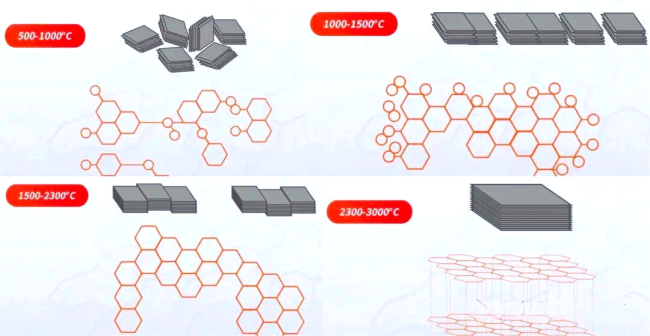
Graphitization is the core process in graphite anode production. By placing the material in a graphitization furnace at around 3000°C for high-temperature heat treatment, the atomic arrangement is altered to optimize graphite performance.
At the microscopic level, the carbon atom arrangement transforms from stacked planar network layers into a three-dimensional ordered structure. This improves electrical conductivity, reduces impedance, and removes impurities. For 3C-type and high-end products, high-temperature carbonization is often applied afterward to further upgrade performance.
Graphitization can reduce the content of oxygen-containing functional groups (such as hydroxyl and carboxyl groups) on the graphite surface. The amount of these functional groups is closely related to side reactions and has a significant impact on lithium-ion battery performance.
Reasons for Reducing Oxygen-Containing Functional Groups:
Active sites for side reactions:These groups readily react with the electrolyte, consuming electrolyte and active lithium, damaging the SEI film, and accelerating capacity fade.
Impact on SEI film stability:Excessive electrolyte decomposition prevents the SEI film from effectively isolating graphite from the electrolyte, shortening cycle life.
Aggravated oxidation and corrosion: In certain environments, they can become oxidation initiation sites, reducing conductivity and accelerating matrix corrosion.
Increased interfacial impedance: Enhanced interaction with the electrolyte forms high-impedance layers, hinders Li⁺ diffusion, and degrades rate performance.
02 Effect of Cooling Rate on Graphitization
The cooling rate is a critical parameter. Rapid cooling can cause multiple adverse effects; therefore, stepwise cooling is required:
Increase in lattice defects: Carbon atoms cannot stack in an orderly manner, leading to lattice distortion and microcracks, which impair conductivity and lithium-ion intercalation.
Generation of internal stress: Large temperature gradients between the surface and interior cause particle cracking and fragmentation, affecting tap density and flowability.
Increase in oxygen-containing functional groups: Reactions with residual gases generate more functional groups, increasing the risk of side reactions.
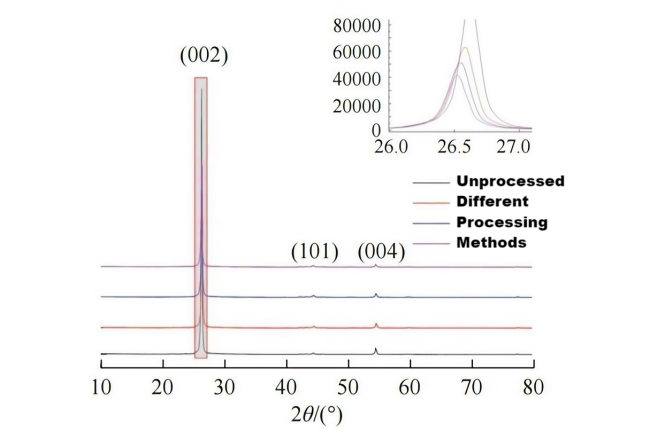
Reduced crystallinity and degree of graphitization: Interrupted carbon atom arrangement lowers conductivity and lithium-ion diffusion capability, degrading battery performance.
(Supplement: d002 peak broadening and reduced graphitization degree; consistent with the carbon coating logic below.)
Impact on processability: Reduced tap density and flowability lead to electrode processing issues and lower finished product yield.
03 High-Temperature Carbonization Process
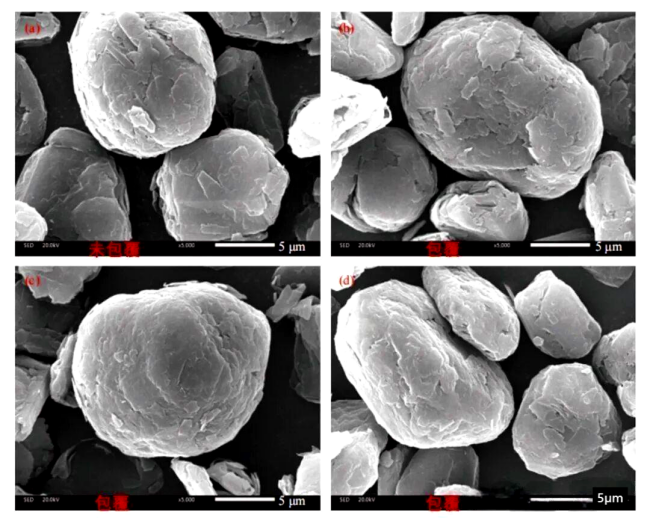
For 3C-type and high-end products, after graphitization, pitch or resin is coated onto the surface of the graphitized material and carbonized at 1000–1200°C. The amorphous carbon formed from pitch can repair surface defects, reduce specific surface area, and enhance rate capability, fast-charging performance, and storage performance.
Advantages of Pitch or Resin Coating:
Improved electrical conductivity: Reduces inter-particle contact resistance, lowers electron transport barriers, and enhances battery rate performance.
Optimized lithium-ion intercalation/de-intercalation: Reduces direct contact with the electrolyte, suppresses side reactions, provides more intercalation channels, and improves cycling stability.
Enhanced stability and corrosion resistance: Forms a physical barrier that isolates corrosive media and extends material service life.
Morphology and particle size control: Adjusts particle size distribution and sphericity, improving tap density and flowability, and facilitating processing.
Suppression of volume expansion: Buffers stress, inhibits particle fracture, maintains electrode structure, and improves battery cycle life.
Feel free to contact us anytime for more information about the Anode Material market. Our team is dedicated to providing you with in-depth insights and customized assistance based on your needs. Whether you have questions about product specifications, market trends, or pricing, we are here to help.
No related results found




0 Replies