




【Petroleum Coke】Strong Prices in February, Weak Demand, and U.S. Coal Expanding...

Calcined petroleum coke, with its high carbon content, low sulfur, and low impurities, plays a vital role in modern manufacturing, especially in the aluminum and steel industries.
【Petroleum Coke】Strong Prices in February, Weak Demand, and U.S. Coal Expanding in the Indian Market
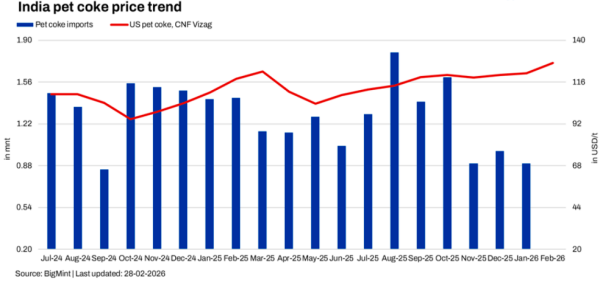
By the end of February 2026, the global petroleum coke market remained generally firm. However, purchasing activity slowed as Indian cement companies reassessed fuel economics. Tight supply conditions have kept petroleum coke prices at elevated levels, while high-calorific U.S. coal—particularly Northern Appalachian coal (NAPP)—has emerged as a strong competitor to petroleum coke in the Indian market.
Global Market Still Supported
Petroleum coke prices across different regions have remained at relatively high levels. High-sulfur coke from the U.S. Gulf Coast is quoted at around $85 per ton FOB, while delivered prices in major markets are also firm. In Northwest Europe and Brazil, medium-sulfur coke is priced close to $115 per ton CFR, reflecting stable industrial demand in those regions.
In the Asian market, petroleum coke demand in China weakened after the Spring Festival, with inventories rising and buyers remaining cautious. However, due to constrained supply growth and the lack of any substantial increase in refinery output, prices continue to receive solid support.
Overall, although the global petroleum coke market has not experienced a dramatic surge, the supply–demand structure remains relatively tight.
Indian Market: High Prices Meet Purchasing Resistance
India is currently the most influential price-driving factor in the seaborne petroleum coke market. High-sulfur petroleum coke delivered to India's west coast is generally quoted in the $128–132 per ton CFR range, with most sellers unwilling to lower prices. At the same time, increased competition in freight rates has helped keep delivered prices stable even when FOB prices rise.
Despite the firm market trend, actual transactions remain limited. Several Indian cement producers are reducing petroleum coke inventories ahead of the end of the fiscal year in March in order to improve cash flow and streamline supply chains. At current price levels, most buyers lack the motivation to purchase new cargoes.
The market expects restocking activity to resume in April. Before the arrival of the monsoon season, India's construction industry typically experiences a short but strong period of activity, which will drive a rebound in cement production. After the monsoon season slows demand, cement companies generally maintain low inventory levels unless fuel prices become particularly attractive.
U.S. Coal Becomes a Key Competitor
The most notable change in the market is the growing competitiveness of high-calorific U.S. coal.
Northern Appalachian coal from the United States is currently offered to India at $123–125 per ton CFR, slightly lower than petroleum coke prices. Some deals have already been concluded at these levels, particularly among buyers in urgent need of fuel or those seeking to diversify fuel sources and reduce dependence on high-priced petroleum coke.
This competitive dynamic is reshaping purchasing decisions in the market. Indian cement producers typically blend low-ash, high-calorific fuels with domestically produced high-ash coal during production. Petroleum coke has traditionally been the preferred blending fuel. However, when the price gap between the two narrows, high-calorific coal can substitute for part of the petroleum coke demand.
At present, the price ranges of petroleum coke and high-calorific coal have become very close, and buyers are increasingly inclined to choose the option that offers better short-term economics or easier availability.
Supply Constraints Support High Prices
Tight supply remains the key reason petroleum coke prices continue to stay elevated. Refinery shutdowns and operational adjustments in the United States have reduced global petroleum coke availability. Meanwhile, Chinese buyers are actively purchasing non-U.S. petroleum coke, further tightening supply.
Demand from the Chinese market is particularly influential. Because U.S. petroleum coke is still affected by China's tariff policies, Chinese buyers are competing for supplies from the Middle East and other non-U.S. sources, often bidding higher than Indian buyers. This has made the Indian market highly dependent on petroleum coke from the U.S. Gulf Coast, helping maintain the tight structure of the global petroleum coke market.
The coal market is also experiencing supply constraints. Inventories of imported Northern Appalachian coal at Indian ports remain low, and recent shipment data show that this coal continues to flow steadily into the Indian domestic market. This indicates that even at relatively high prices, the market still has the capacity to absorb the supply, which in turn supports the overall pricing of high-calorific fuels.
Market Outlook: Short-Term Softness, Mid-Term Support
Looking ahead, petroleum coke prices may weaken slightly in the short term as buyers reduce inventories and postpone purchases ahead of the monsoon season.
However, the market still has strong support in the medium term. Cement producers continue to require low-ash blending fuels, petroleum coke supply growth remains limited, and high-calorific coal prices are rising alongside petroleum coke. Even if demand experiences temporary stagnation, fundamental supply–demand conditions suggest that petroleum coke prices will remain firm.
Therefore, India will continue to be the core market in global petroleum coke trade in 2026. As long as cement demand remains stable and the need for fuel blending persists, the correlation between petroleum coke and high-calorific U.S. coal will remain strong. The two fuels are not completely interchangeable, but rather competing products within the same economic framework.
Feel free to contact us anytime for more information about the petroleum coke market. Our team is dedicated to providing you with in-depth insights and customized assistance based on your needs. Whether you have questions about product specifications, market trends, or pricing, we are here to help.
No related results found




0 Replies