




【Steel】Analysis of China's Steel Exports in Q1 2026

Graphite electrodes are the "lifeline" of EAF steelmaking! As the core material for arc conduction and heating, they feature high conductivity and heat resistance, directly affecting molten steel quality and output. Mastering graphite electrodes means mastering the initiative in EAF steelmaking!
【Steel】Analysis of China's Steel Exports in Q1 2026
In the first quarter of 2026, China's steel product exports (billet + finished steel) showed the characteristics of a slight overall decline, a sharp increase in billet exports, a decline in finished steel exports, and significant differentiation in both regional and product structures. Under the combined effects of diverging global steel demand, changes in the trade environment, and adjustments in domestic supply pace, the export market exhibited the features of "strong billet, weak steel products, weak flat products, and strong long products," with continuous optimization and adjustment of export regional layout and product structure.
I. Total Exports: Slight Overall Decline, Divergence Between Billet and Steel Products
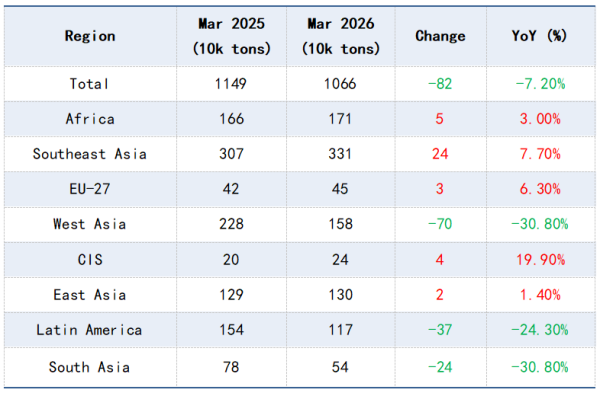
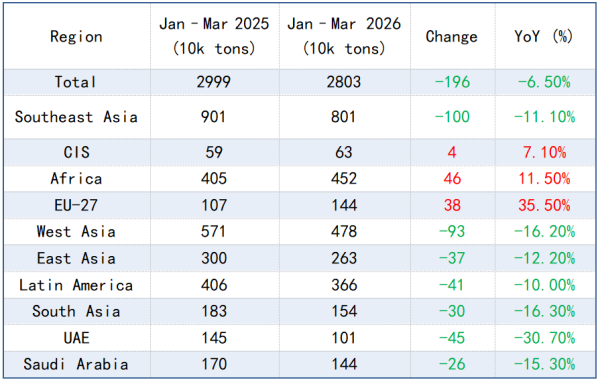
In Q1 2026, China's combined exports of billet and finished steel reached 28.03 million tons, a decrease of 1.96 million tons compared with 29.99 million tons in the same period of 2025, representing a year-on-year decline of 6.5%. In March alone, total exports reached 10.66 million tons, down 7.2% YoY, with the monthly decline slightly larger than the cumulative Q1 decline.
From a regional perspective, Africa, the EU-27, and the CIS became the core growth drivers in Q1. Among them, exports to Africa reached 4.52 million tons, up 11.5% YoY; exports to the EU-27 reached 1.44 million tons, up 35.5%; and exports to the CIS reached 0.63 million tons, up 7.1%.
Exports to traditional major markets generally declined. Southeast Asia recorded 8.01 million tons in Q1, down 11.1% YoY; West Asia 4.78 million tons, down 16.2%; East Asia 2.63 million tons, down 12.2%; Latin America 3.66 million tons, down 10.0%; South Asia 1.54 million tons, down 16.3%; the UAE 1.01 million tons, down 30.7%; and Saudi Arabia 1.44 million tons, down 15.3%. Demand in traditional Asian and Middle Eastern markets weakened significantly.
From March data alone, regional differentiation became even more pronounced. Exports to West Asia decreased by 0.70 million tons YoY, down 30.8%, contributing 85% of the total export decline, mainly due to geopolitical risks. Meanwhile, exports to Southeast Asia increased by 7.7%, Africa by 3.0%, EU-27 by 6.3%, CIS by 19.9%, and East Asia slightly by 1.4%. Latin America declined by 24.3%, and South Asia by 30.8%. Exports to Southeast Asia and East Asia shifted from decline in January–February to growth in March.
Figure 1: Combined Exports of Steel and Billet in March 2026
Source: Steel Union Data
Figure 2: Combined Exports of Steel and Billet in Jan–Mar 2026
Source: Steel Union Data
From a product perspective, billet exports maintained rapid growth and became the core support of steel exports in Q1. From January to March 2026, China exported 3.30 million tons of billet, an increase of 0.74 million tons compared with 2.56 million tons in the same period of 2025, up 29.0% YoY. In March alone, billet exports reached 1.53 million tons, up 48.4% YoY, maintaining a high growth rate and indicating strong overseas demand.
Finished steel exports continued to decline, dragging overall exports. From January to March 2026, finished steel exports totaled 24.73 million tons, down 2.70 million tons from 27.43 million tons in the same period of 2025, a YoY decline of 9.9%. In March alone, exports were 9.13 million tons, down 12.6% YoY, with the monthly decline exceeding the cumulative Q1 decline, indicating increasing pressure on steel exports.
II. Product Structure: Flat Products Weaken, Sections Grow, Wire Rod Stable
In Q1 2026, export performance across steel product categories showed significant divergence. Flat products generally declined, long products grew against the trend, and wire rod remained stable.
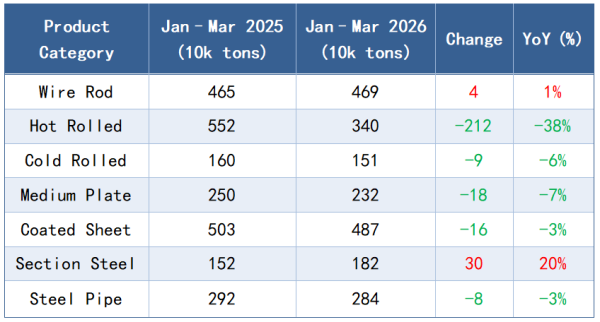
Wire rod exports remained stable at 4.69 million tons, slightly up by 0.04 million tons from 4.65 million tons in the same period of 2025, representing a 1% YoY increase. It was the most stable category among major steel products and supported the base demand for construction steel exports.
Hot-rolled products saw a sharp decline and became the main contributor to the reduction in steel exports. Exports of hot-rolled products were 3.40 million tons, down 2.12 million tons from 5.52 million tons in the same period of 2025, a YoY decline of 38%, the largest among all categories, largely affected by overseas anti-dumping measures.
Cold-rolled, medium plate, coated sheet, and steel pipe exports declined slightly. Cold-rolled exports reached 1.51 million tons, down 6%; medium plate 2.32 million tons, down 7%; coated sheet 4.87 million tons, down 3%; and steel pipe 2.84 million tons, down 3%. These products showed relatively stable performance with single-digit declines.
Section steel exports achieved double-digit growth and became a highlight. Exports reached 1.82 million tons, up 0.30 million tons from 1.52 million tons in the same period of 2025, representing a 20% YoY increase. It was the only major category with strong growth, benefiting from the recovery of overseas infrastructure and industrial demand.
Figure 3: Export Volume by Steel Product Category (Jan–Mar 2026)
Source: Steel Union Data
Feel free to contact us anytime for more information about the EAF Steel market. Our team is dedicated to providing you with in-depth insights and customized assistance based on your needs. Whether you have questions about product specifications, market trends, or pricing, we are here to help.
No related results found




0 Replies