




【Petroleum Coke】Cost Support and Tightened Supply Drive Continued Price Increases

The rapid growth of the EV and energy storage industries is boosting demand for high-performance lithium batteries, driving the market for quality petroleum coke and synthetic graphite. The quality and particle size of calcined petroleum coke directly affect synthetic graphite performance, especially in anode production.
【Petroleum Coke】Cost Support and Tightened Supply Drive Continued Price Increases
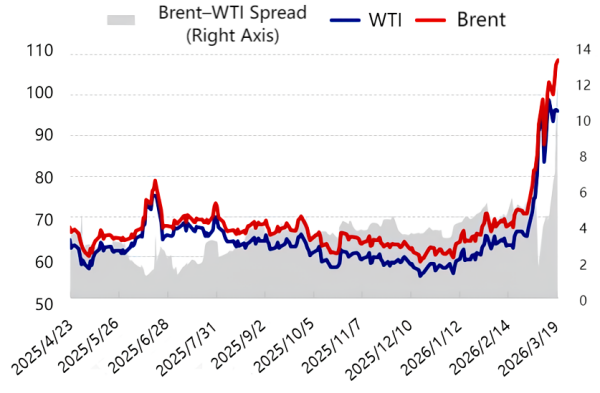
International crude oil prices remain at high levels with fluctuations, providing cost-side support to the petroleum coke market. On the supply side, domestic refinery daily output of petroleum coke continued to decline slightly in March. As more refineries enter maintenance, domestic petroleum coke supply is expected to decrease further. In the short term, cost drivers, tightening supply, and rigid demand are supporting petroleum coke prices.
I. Crude Oil Prices Fluctuate at High Levels,
Residual Oil Negotiation Focus Moves Upward
2025–2026 International Crude Oil Price and Spread Trend Chart
(USD/barrel, right axis: USD/barrel)
2025–2026 Weekly China Residual Oil Spot Price Comparison Chart
(RMB/ton)
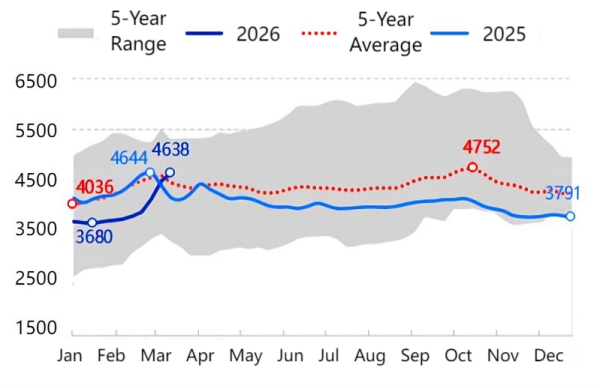
As of March 20, crude oil prices showed mixed movements, while residual oil spot prices continued to rise. Due to ongoing conflicts and uncertainty over the reopening of the Strait of Hormuz, long-term supply risks remain high. Refineries are reluctant to sell at low prices, although high-priced transactions are limited. Major northern refineries have begun maintenance, tightening supply. Coupled with a sharp rise in gasoline and diesel prices mid-week, bullish sentiment among market participants has strengthened, and the negotiation center for residual oil has steadily moved upward. Mainstream low-sulfur residual oil is traded at RMB 4,450–4,980/ton, up RMB 90–300/ton from the previous period. Medium-sulfur residual oil is at RMB 4,500–4,900/ton, up RMB 100–200/ton. High-sulfur residual oil trades at RMB 4,000–4,800/ton, rising by RMB 250/ton at the high end.
2026 Weekly Profit Comparison of Petroleum Coke and Downstream Products
(RMB/ton)
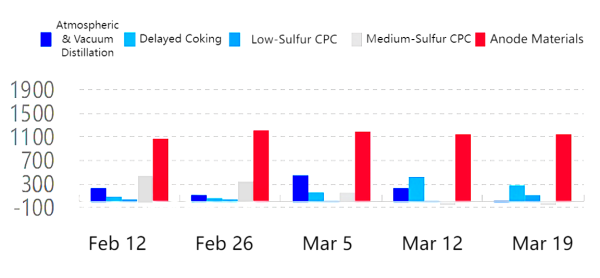
From the perspective of industry chain profits, affected by rising costs, profits for petroleum coke and downstream products declined this week. In Shandong, local refinery atmospheric and vacuum distillation profit was RMB 29/ton, down RMB 198/ton or 87.22% week-on-week. The theoretical processing profit of delayed coking units was RMB 281/ton, down RMB 153/ton or 35.25%. Low-sulfur calcined coke profit was RMB 124/ton, up RMB 100/ton or 416.67%. Medium-sulfur calcined coke profit was -RMB 59/ton, down RMB 6/ton or 11.32%. Anode material profit stood at RMB 1,139/ton, remaining stable week-on-week.
II. Some Refineries Adjust Operating Rates,
Domestic Petroleum Coke Supply Slightly Decreases
2026 Weekly Output of Domestic Refinery Petroleum Coke (Unit: 10,000 tons)
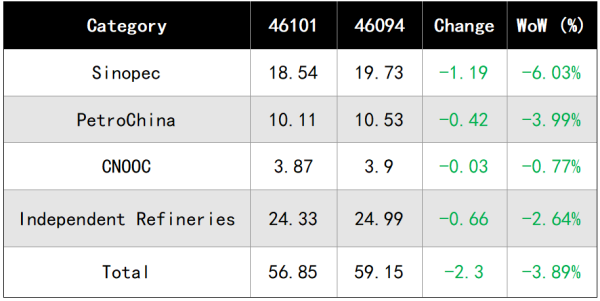
This week, domestic petroleum coke supply decreased. Output was 568,500 tons, down 23,000 tons or 3.89% from the previous period. The operating rate of delayed coking capacity was 64.78%, down 2.63 percentage points. The decline was mainly due to maintenance shutdowns at Sinopec's Shijiazhuang refinery, along with processing load adjustments at PetroChina and Sinopec refineries. Among local refineries, Jiangsu Xinhai Petrochemical's 1 million t/year delayed coking unit entered maintenance shutdown, while Jingbo Petrochemical's 400,000 t/year unit resumed operations. Sinopec refineries mainly carried out planned maintenance, while local refineries were dominated by unplanned maintenance. Supply risks caused by instability in the Middle East remain present.
III. Rigid Downstream Demand Provides Support,
Procurement Sentiment Remains Acceptable
Downstream carbon markets maintain stable operating rates, with solid support from end-user markets, benefiting petroleum coke shipments. The domestic calcined coke operating rate is 57.9%, up 0.15 percentage points. Most enterprises are currently fulfilling orders, and due to high raw material costs, procurement remains cautious and mainly based on rigid demand. The prebaked anode market operates steadily, providing stable support to the petroleum coke market. The operating rate of anode materials declined by 1 percentage point, while leading enterprises maintain high utilization, supporting active trading in the low-sulfur coke market. In the short term, rigid downstream procurement continues to support the petroleum coke market.
Overall, the impact of geopolitical conflicts on supply and market sentiment remains dominant in the short term. Petroleum coke supply is expected to continue declining, port inventories are decreasing slowly, and the petroleum coke price index is likely to rise slightly.
Feel free to contact us anytime for more information about the Anode Material market. Our team is dedicated to providing you with in-depth insights and customized assistance based on your needs. Whether you have questions about product specifications, market trends, or pricing, we are here to help.
No related results found




0 Replies