




【Steel】New Export Regulations and RMB Appreciation — Analysis of China's Steel Export...

Graphite electrodes are the "lifeline" of EAF steelmaking! As the core material for arc conduction and heating, they feature high conductivity and heat resistance, directly affecting molten steel quality and output. Mastering graphite electrodes means mastering the initiative in EAF steelmaking!
【Steel】New Export Regulations and RMB Appreciation — Analysis of China's Steel Export Data in Jan–Feb
Since the post-Spring Festival resumption of work, both offshore and onshore RMB against the USD broke above the 6.85 level on February 27, reaching a new high since April 14, 2023. Since the implementation of the new export licensing policy, China's cumulative steel exports in Jan–Feb 2026 totaled 15.591 million tons, down 8.1% year-on-year. For China's steel industry, which is deeply embedded in the global supply chain, the standardization of export licenses and RMB appreciation are transmitting through multiple channels including export order profits, iron ore prices, and capital turnover. Below is a brief analysis of the steel export market from the perspective of exchange rate adjustments.
PART 01
Record Export Data in Q4 2025
Source: Mysteel Data
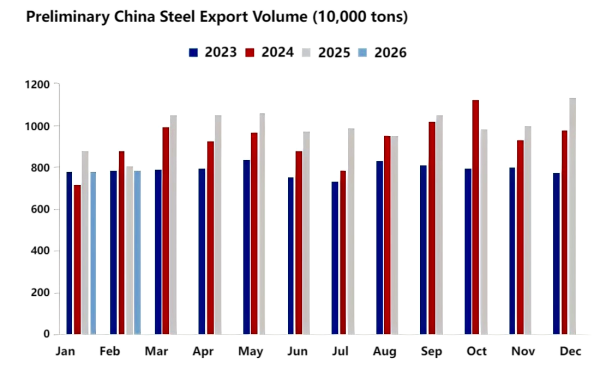
From the chart of China's monthly steel export data, it can be observed that export performance in Q4 2025 differed from previous years. After reaching a high of 9.782 million tons in October, exports continued to strengthen, hitting a three-year high of 11.301 million tons in December. The main reason is that export license management measures were officially implemented on January 1 this year, leading to a noticeable rush of orders before year-end.
It is worth noting that after the implementation of the export licensing system, exports did not see a cliff-like drop in January. Steel exports in January were 7.754 million tons, a year-on-year decrease of 995,000 tons (down 11.37%); February exports were 7.837 million tons, a year-on-year decrease of 199,000 tons (down 2.47%). This indicates that the market is gradually digesting the new policy. It is expected that steel exports in March may reach around 10 million tons. Industry feedback shows that large steel mills, with more comprehensive compliance systems, have largely adapted to the new regulations, while small and medium-sized traders face higher procedural and time costs, which may restrain their exports to some extent.
PART 02
Country Distribution
Source: Mysteel Data, China Customs
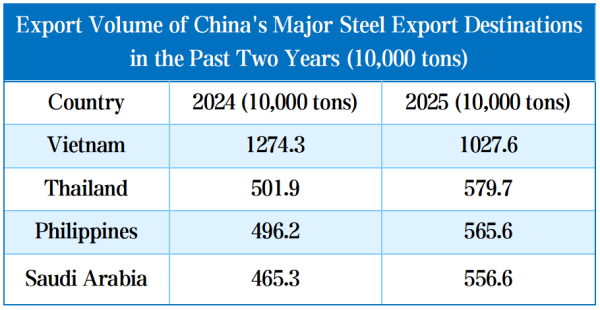
From the export flow over the past two years, Southeast Asia remains China's primary export region. According to surveys on coated steel products, due to increasing anti-dumping measures and the licensing system, about 3–5% of orders have shifted to other countries. However, given China's advantages in product quality and supply chain efficiency, this shift has not developed into a large-scale trend.
PART 03
Impact of RMB Appreciation on Costs and Profits
1. Export Profit of Hot-Rolled Coil
Source: Mysteel Data
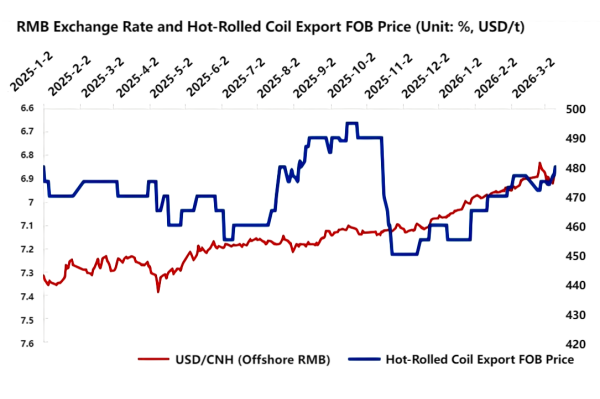
Taking hot-rolled coil, a mainstream export product, as an example, the current FOB export price is about USD 480 per ton. Before the exchange rate change, USD 480 could be converted into approximately RMB 3,360; after the change, the same amount converts to about RMB 3,292. This means that the RMB revenue per ton after settlement decreases by about RMB 70, equivalent to an indirect increase of nearly 2% in FOB price. For the steel industry, which already operates on thin margins, this change directly affects the competitiveness of export orders.
2. Iron Ore Procurement Costs
Source: Mysteel Data
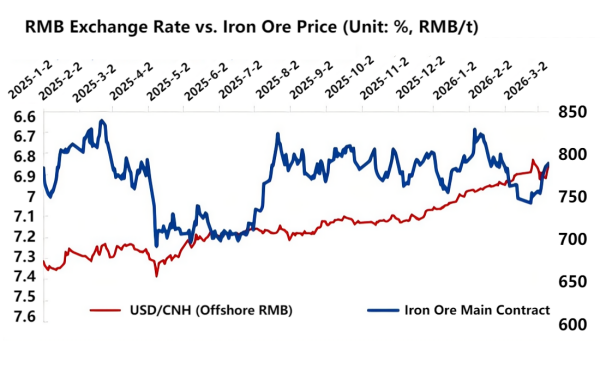
From a cost perspective, iron ore is a key component in steel production. Imported iron ore accounts for nearly 50% of production costs and is mainly priced in USD. RMB appreciation theoretically reduces the cost of raw material procurement in RMB terms.
Overall, iron ore imports may become slightly cheaper, saving about RMB 15–25 per ton. However, exports become more difficult, with profit margins reduced by RMB 20–50 per ton. After offsetting, the net impact is an increase of about RMB 5–25 per ton in cost. This cost transmission has a time lag, and the actual impact varies across companies depending on procurement cycles and foreign exchange risk management capabilities.
PART 04
Anti-Dumping Investigations on Chinese Steel Products in 2026
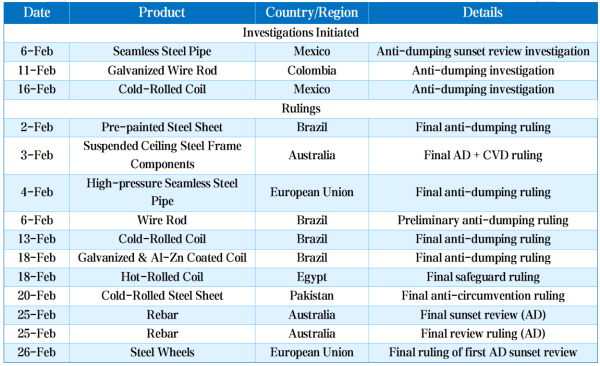
Source: Compiled by Mysteel from public information
On February 16, Mexico's Ministry of Economy initiated an anti-dumping investigation into cold-rolled coils from China. At the same time, previous anti-dumping rulings by countries such as Brazil and Pakistan on Chinese cold-rolled coils have been successively implemented. Brazil has imposed high anti-dumping duties on the products involved, with a validity period of up to five years, while Pakistan has imposed anti-dumping duties on related cold-rolled products through an anti-circumvention review ruling. The frequent occurrence of global trade remedy investigations in the steel sector has further increased the pressure on China's steel exports.
PART 05
Summary
Factors such as the standardization of export licenses, RMB appreciation, and the increase in anti-dumping cases have all added pressure to exports. In the short term, RMB appreciation weakens the price advantage of exports, and export orders face reduced profits of tens of RMB per ton. However, in the long term, these pressures may drive industrial upgrading. It is precisely this pressure that forces enterprises to move away from the traditional "low-margin, high-volume" model and seek added value through technology, services, and supply chain stability.
At the same time, although the export licensing system increases administrative costs, it also helps regulate market order. Despite the short two-month window, the market has already shown unexpected adaptability. The real test lies in whether enterprises can respond effectively when the long-term effects of the system begin to reshape industry structure and filter export categories. Current export data for Jan–Feb indicate that China's steel export position remains solid. However, price adjustments in overseas markets have partially absorbed the rising export costs from China, and some order transfers are occurring, posing a challenge to maintaining market share.
Feel free to contact us anytime for more information about the EAF Steel market. Our team is dedicated to providing you with in-depth insights and customized assistance based on your needs. Whether you have questions about product specifications, market trends, or pricing, we are here to help.
No related results found




0 Replies