




【In-Depth Insight】Is Shaft Furnace Cost 8% Lower? Comparison of Petroleum Coke Calcination Processes

The rapid growth of the EV and energy storage industries is boosting demand for high-performance lithium batteries, driving the market for quality petroleum coke and synthetic graphite. The quality and particle size of calcined petroleum coke directly affect synthetic graphite performance, especially in anode production.
【In-Depth Insight】Is Shaft Furnace Cost 8% Lower? Comparison of Petroleum Coke Calcination Processes
The process in which carbonaceous raw materials undergo high-temperature (1200–1500°C) heat treatment under air-isolated conditions is called calcination. During the calcination process, carbonaceous materials experience both physical and chemical changes. The changes occurring in the low-temperature drying stage (below 200°C), mainly moisture removal, are essentially physical changes; while in the stage of volatile release, chemical changes dominate, including the decomposition of aromatic compounds and polycondensation reactions.
The main purposes of calcination are usually as follows:
① To remove moisture and volatile matter from the raw materials.
Carbon materials usually contain a certain amount of volatile matter. After calcination, these volatiles are removed, thereby increasing the fixed carbon content. Carbon raw materials generally contain 3–10% moisture; removing this moisture through calcination facilitates crushing, screening, and grinding processes, improves the adsorption performance of binders, and helps enhance product quality.
② To increase the density and mechanical strength of the raw materials.
Due to the removal of volatiles, the material shrinks in volume, leading to increased density and improved strength, while also achieving better thermal stability, thus reducing secondary shrinkage during subsequent calcination. The more complete the calcination, the more beneficial it is to product quality.
③ To improve the electrical conductivity of the raw materials.
After calcination, volatiles are removed and the molecular structure changes, reducing resistivity and improving electrical conductivity. Generally, the higher the degree of calcination, the better the conductivity of the calcined material.
④ To enhance the oxidation resistance of the raw materials.
With increasing temperature, through pyrolysis and polymerization processes, impurities such as hydrogen, oxygen, and sulfur are gradually removed. Chemical activity decreases, and physicochemical properties become more stable, thereby improving oxidation resistance.
(The calcination quality of raw materials is generally controlled by two indicators: powder resistivity and true density. The higher the degree of calcination, the lower the powder resistivity and the higher the true density.)
Petroleum coke calcination processes are divided into two types:
One is the rotary kiln calcination process
The other is the shaft (pot) calcination process
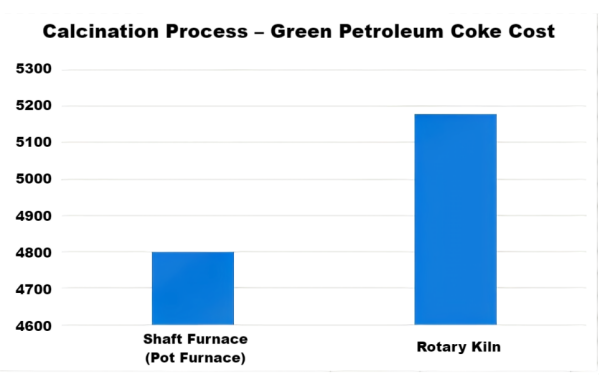
The coke yield rates of the two processes are approximately 73% and 78% (75%–80%), respectively, which determines the main cost difference between calcined coke produced by these two processes.
For example, if both types of plants purchase green petroleum coke at a unit price of RMB 3,779/t as raw material, the cost comparison is shown in the figure below.
Shaft Calcination Furnace (Pot Calciner)
Advantages: Stable calcination quality, low oxidation loss of materials, high purity of calcined products, full utilization of volatiles, and relatively high overall thermal efficiency.
Disadvantages: Large and complex furnace structure, requiring substantial steel and various special-shaped refractory bricks, long construction period, and high capital investment.
Rotary Kiln Calcination Furnace
Advantages: Simple structure, single material composition, low construction cost, and fast installation. High production capacity, flexible raw material switching, strong adaptability to different raw materials, suitable for calcining various carbonaceous materials. Easy to realize mechanization and automation. Low fuel consumption and long service life, generally 20–30 years.
Disadvantages: High oxidation loss of materials, generally around 10%. The refractory lining of the kiln body is prone to wear and detachment, leading to increased ash content and frequent maintenance.
Comparison of Advantages and Disadvantages between Shaft Furnace and Rotary Kiln
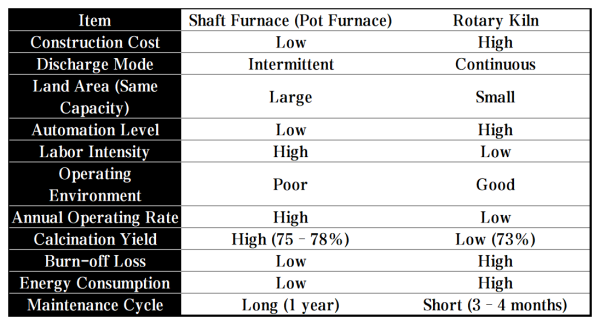
Both processes have their own advantages. It is understood that the shaft furnace calcination process is more widely used in the current market to increase coke yield and improve profitability.
Feel free to contact us anytime for more information about the calcined petroleum coke market. Our team is dedicated to providing you with in-depth insights and customized assistance based on your needs. Whether you have questions about product specifications, market trends, or pricing, we are here to help.
No related results found




0 Replies